

The new Width of a Post podcast is now available!
It has been another eventful period for Bradford City, with the sacking of Mark Hughes following a slow start to the season. We discuss where it went wrong for the Welshman, and the legacy he leaves behind.
Also in this episode of the podcast, Jason McKeown, Tim Penfold and Alex Scott look at:
- Why more possession spelled bad things for Hughes and City.
- Kevin McDonald’s dream start as caretaker.
- The next manager runners and riders – who sounds just like Hughes, and who might offer something very different?
- The familiar debate about the club’s direction from the top.
- When have you been proven wildly wrong with a Bradford City opinion? Starring Barry Conlon, Stephen Warnock, Simon Francis, Chris Routis, Stephen Darby, Mark Yeates, Chib Chilaka, Peter Beagrie, Graeme Lee, Will Atkinson and Alex Jones!
- (And yes, because we couldn’t stop him, more Bobby Pointon praise from Tim!)
You can listen below on Soundcloud and it is also on iTunes:
Hughes’ true downfall
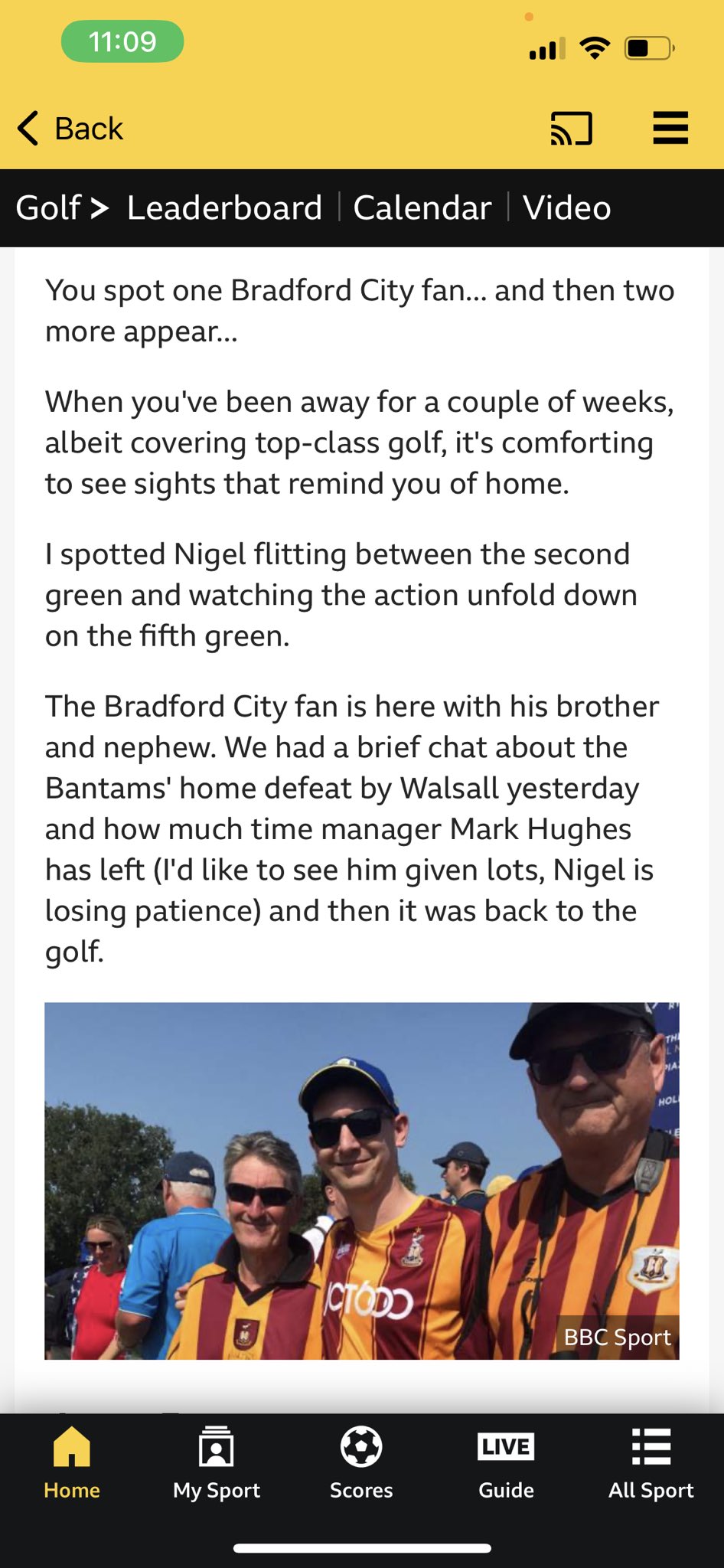
As we talk about on the podcast, disgruntlement over Hughes’ time at Valley Parade even made it to the international stage of the Ryder Cup. With the Scott family (who were attending in Italy) asked by the BBC website for their views on the under-pressure City boss.
Alex’s uncle Nigel did not hold back…
Possession
On the pod, Alex also researches the startling difference between Hughes’ Bradford City when they had lots of the ball, compared to games when they didn’t.
When City had 55% or more possession, they were one of the most unsuccessful teams in League Two. When they had less than 55% of the ball, they were a winning machine!

Categories: Podcast
 The Width of a Post podcast #72: Travel Sickness
  Quick Hit podcast: January window reflections
  Quick Hit podcast: Town 1 City 0
  Width of a Post podcast special – Andy Cook and a Tidal Wave of News (and Cardiff)
  widthofapost.com
I wonder if the lads at the Ryder Cup were the ones shouting ‘Yorkshire‘Yorkshire 😂 I thought when I heard it that it had to be a City supporter.
After our 4-1 win at Newport. Simon Parker, of the Telegraph and Argus, had referred to the team playing 300 passes less than during the previous game against Harrogate at home. This got me thinking back to Mark Hughes’ namesake, A few decades ago Charles Hughes was a Director of Football for the FA -I still have the official FA Coaching manual he wrote from my “FA Coach” days- and both his and a chap named Charles Reeps’ analysis on “possesion” and its relationship to scoring goals and winning games is very relevant to this subject.
Both Charles Reep and Charles Hughes argued, through the use of their basic and heavily criticised analyses, that most goals are scored with 3 passes or less.
It was interesting to note that four of the 5 goals that were scored during City’s game at Newport could be argued to have been scored with 3 passes or less -the only goal that consisted of more than 3 passes was the first goal. This came after ten passes and was an excellent piece of interplay from City.
I am a great believer in the Brian Clough approach to football. He argued that a player should always look to play a forward pass first. (You can take a whole line of defenders out of the game by passing a ball forward and then getting players to support and or make themselves available to receive a pass).
Charles Hughes’ and Charles Reep’s philosophy of getting the ball forward quickly has been termed the ‘long ball” game. Personally, I have never had a problem with the long ball game. Particularly when it is accurate and forces defenders to turn or creates opportunities for team-mates to attack the opposition’s last line of defence which then increases the opportunity for a shot or an opportunity to get a cross in from the goal line. One of the major benefits of this approach over MH’s majority of games in charge has to be that when City are at home it gets the crowd involved and this, as Gilly refers to above, can only be a negative for the visiting teams to VP and a positive for City.
Having said all that, the approach doesn’t need to be all “long ball” the points is that the passing has to be mostly forward and played quickly and players have to be encouraged to run with the ball at defenders. If possession is lost, which it will, at least the ball should be high up in the opposition’s half where a high press can then take place. It’s certainly easier on the eye for the “customers” and safer than losing possession 30 yds out from your own goal-line.