
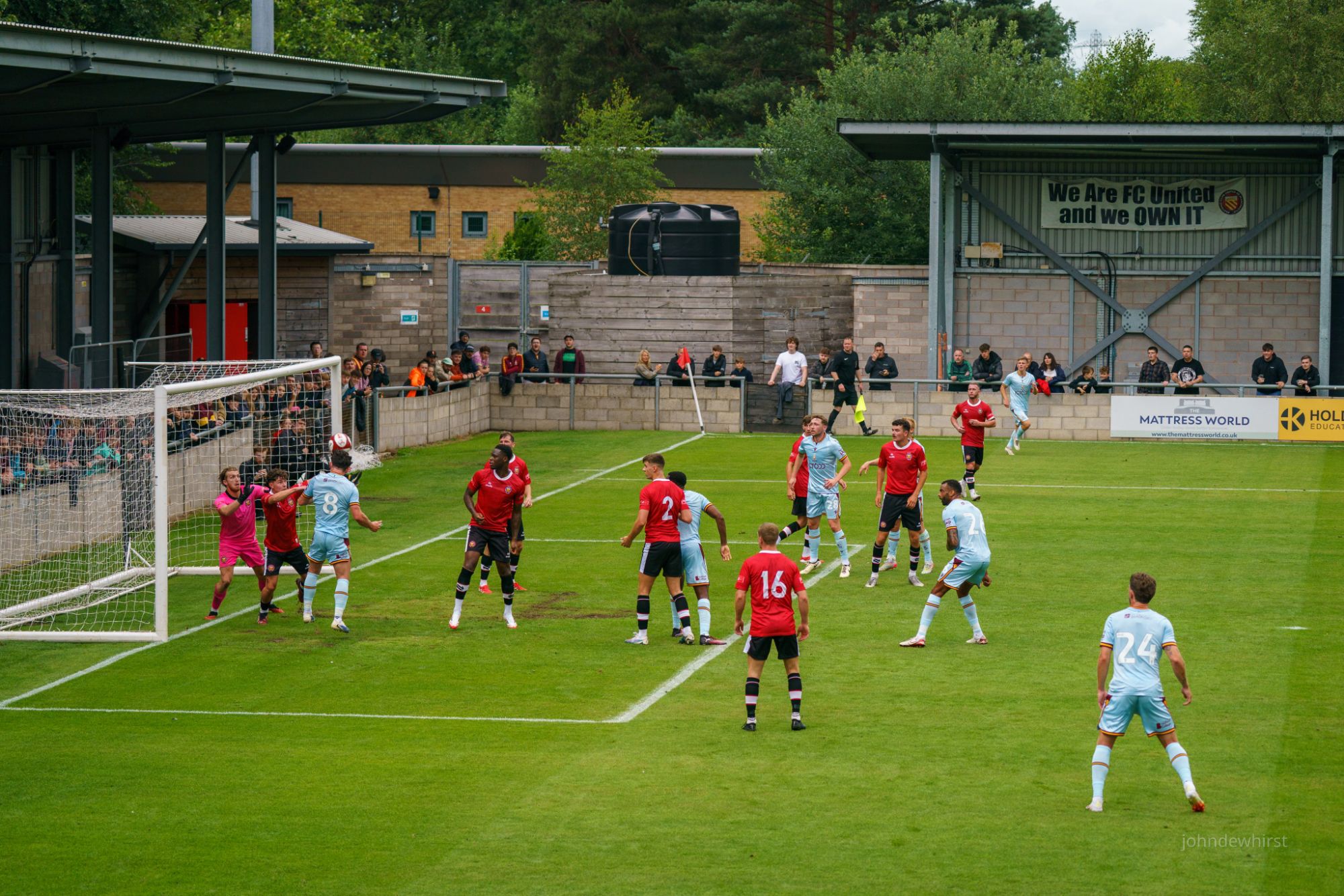
Written by Tim Penfold, Alex Scott and Jason McKeown (images by John Dewhirst)
Pre-amble
By Jason
The days of having a settled first Bradford City XI really do seem to be behind us. Over the never-to-be-forgotten 2024/25 campaign, just three players started 32 or more league matches (70% of games). Those three players were Sam Walker, Brad Halliday and Richie Smallwood.
You have to go back to 2010/11 for the last time fewer players started more than 70% of City’s league games. That season (the Peter Taylor/Peter Jackson year) only the Lukes of Oliver and O’Brien made the first XI cut more than 32 times. It was a chaotic year of change and failure. And normally, if you go through a season with such few players featuring regularly, it’s because things aren’t going to plan and there’s a scramble for solutions.
That definitely wasn’t the case last season. We saw a lot of different players appear in the league for City – 31 in fact. Many of them played a notable part in the club’s success, even through they didn’t figure every week. Ridiculous injury problems played a part in this, but it was also the case that rotation was the name of the game.
City’s 90+6 exploits were the ultimate vindication of the approach of pacing the squad’s fitness and sharpness by swapping things around. They were so strong in those final 20 minutes of the season, when they might have flagged. They really did keep going right to the very, very end.
And in 2025/26, we can expect this Rotation Revolution to gather pace. Graham Alexander, David Sharpe and Stephen Gent have assembled a large squad, and the strategy would appear to involve switching up the outfield players game to game. City starting XIs are likely to become even more flexible, and even more difficult to predict (especially if you’re an opposition manager). Crucially it also affords City a level of protection from the high likelihood of going through parts of the season with a considerable injury list.
And that sets a different type of expectation for the majority of the squad. Instead of major success being judged as playing almost every game, most players are seemingly going to have to settle for being in and out the side. A brilliant performance on a Saturday might well be rewarded with a place on the bench on the Tuesday.
The Rotation Revolution has also influenced the way we at WOAP have approached what’s become our annual assessment of every member of the squad. For many players, having a major role on City’s fortunes is likely to mean 25-30 starts, supplemented by appearances from the bench. We’ve used this hypothesis to analyse their prospects.
So let’s get into this – our traditional deep dive. Starting with part one, and a look at the backline options for City’s likely 3-4-3 set-up.
Goalkeepers

Sam Walker
By Alex
Sam Walker is back on a freshly-inked two-year deal to be City’s starting keeper. He’s been pretty much a revelation since he came in to replace Harry Lewis, fluctuating between above average and great, playing every league minute in the past 18 months.
Walker has grown into a leadership role in the squad and stepped up in some massive moments toward the end of last season, the penalty save in the win over Crewe that sent City top in April chief among them. He’s got a track record at this level, and given the overall recruitment strategy valuing commitment, experience and leadership, keeping the continuity with him seems like a no-brainer.
The value of that continuity could be particularly acute this year in League One, which is quickly becoming where good young keepers go to get experience. Over half the division this year will have brand new keepers, many of these on loan from the Championship and Premier League.
Gab Sutton – who is usually a pretty good set of objective eyes – in his season preview was sceptical of the Walker re-signing (and City’s prospects generally), making the point that “it’s hard to see more than one or two clubs in League One who would trade their own ‘keeper for [Walker]”.
Which might be fair enough. But I think it’s also fair to say, having watched him for 18 months and understanding his role in the squad, I don’t think City would trade Walker in for a 21-year old loan player either, even if they might be more talented.
What a good season looks like: Keeps on doing what he’s doing, avoiding mistakes and largely saving what he’d expect to and stepping up in massive moments to turn games. Sam Walker in 2024/25.
What a great season looks like: Steps up to the level with amazing consistency, underpinning an excellent defence at the level. Ben Williams in 2015/16.
Joe Hilton
By Jason
Joe Hilton turns 26 this October. So far over his career, he’s played just 40 games. He’s operated on the sidelines at Man City, Everton and Blackburn, with loan spells at Marine, Fleetwood, Ross County, Hamilton and Macclesfield delivering mixed levels of game time. So when Hilton moved to Valley Parade last January, he would have been realistic but hopeful.
Eight months on, Hilton is yet to see a minute of City action and starts the season in the wearisome position of back-up goalkeeper. The good news is the retirement of Colin Doyle should at least grant Hilton gametime in the EFL Trophy. The bad news is his arrival last January pushed Sam Walker into delivering some of his best form for the club. And it will take some drop off from City’s number one for Hilton to get his league opportunity.
All he can do is work hard, impress in those midweek trophy outings, and be ready for any Walker loss of form, injury or red card.
Out of contract this summer (with option for a further year), Hilton can only hope that the landscape shifts to give him that opportunity. He’s been waiting an awfully long time for it.
What a good season looks like: He impresses in the cups and helps City have a decent run. This gives him the odd league opportunity where he does okay before dropping back to the bench. Rouven Sattelmaier in 2016/17.
What a great season looks like: He suddenly get his opportunity and absolutely thrives, making himself utterly undroppable by producing a series of superb displays that genuinely elevate City’s league position. Matt Clarke in 1999/00.
Zac Hadi
By Tim
The life of a young third choice goalkeeper is not always easy. There is not an obvious pathway to first team action – no fifteen minute cameos from the bench to impress in.
Zac Hadi is a promising young keeper, but with Sam Walker and Joe Hilton in his way he is most likely going to be warming the bench at best and spending time out on loan if he wants first team action.
Of course, there’s always the possibility of an injury crisis catapulting him into unexpected action – see Neville Southall or Clint Davies – and with a bit of luck he could end up playing in the Football League Trophy, but this season is mostly going to be about learning from the senior keepers and Colin Doyle, and putting that into practice somewhere like Guiseley or Bradford Park Avenue.
What a good season looks like: A couple of good non-league loans and a first team debut in the Football League Trophy. George Sykes-Kenworthy in 2019/20.
What a great season looks like:He gets an unexpected chance at first team action and takes it with both hands. Jon McLaughlin in 2009/10.
Centre backs

Joe Wright
By Tim
Joe Wright joins Bradford City with pretty high expectations. He’s well regarded by his former clubs, and Kilmarnock were sad to see him leave. He’s an experienced head and a solid defender, and it looks like the plan is for him to organise the back three from the heart of it.
He’s looked good in pre-season – comfortable enough on the ball, excellent aerially and positionally adept. The one weakness in his game seems to be a slight lack of pace, but in the middle of the back three that’s a weakness that can be easily compensated for with more mobile wide centre backs.
If Bradford City are to do well this season, it is likely that Joe Wright will play a big part in it.
What a good season looks like: Solid and consistent defensively, and a set piece threat at the other end. Luke Oliver in 2011/12.
What a great season looks like: The mainstay of a hugely impressive defence – he organises well, the team don’t concede many, he pops up with some goals and he’s a player of the year contender. David Wetherall in 2005/06.
Neill Byrne
By Alex
Neill Byrne, now coming off back-to-back promotions with Stockport and City, enters the last year of his contract battling for a place in the team.
Over the last few seasons, City have shown a consistent focus of learning from their mistakes of the previous season (see signing a dozen attacking midfielders last season), and the latest episode is in our backline, with six experienced centre halves on the books (in addition to Jack Hunt and Paul Huntington who are training with the squad) to avoid the travails of last year where they suffered lots of defensive injuries.
The consequence of this will almost certainly be a lot of rotation in the back three, carrying on the trend from last season, where Alexander retained the same back three once in their final 18 games. Byrne only started 24 league games last season, suffering a fair bit through injury, though by the end was the only one consistently retained in defence, starting 10 of the last 12.
This season is likely to more of a challenge, not least that he is already on the sidelines for the next two months. He spent the end of the season on the right of the three, a role which now looks like Matt Pennington’s to lose, or otherwise in the centre, which looks like Joe Wright’s role. So once Byrne returns, he’ll likely be rotating with those two and Aden Baldwin for those two roles.
Out of contract at the end of the year at age 32, Byrne will be looking to consolidate himself at this level, ideally in City’s defensive rotation for next season, and at worst for an upwardly mobile League Two team looking for a proven winner.
What a good season looks like: Fits in well in the defensive rotation, not looking out of place, providing valuable leadership for the team. Nathan Clarke in 2015/16.
What a great season looks like: Continues his run from the end of last season, starting more games than he doesn’t, and proving a safe experienced head at this level. Anthony O’Connor in 2019/20.
Aden Baldwin
By Tim
Until Doncaster away, Aden Baldwin had been pretty impressive in his first campaign as a Bantam. He’d arrived from Notts County with a reputation for technical quality but also for the occasional brain fade, but we’d mostly seen the former rather than the latter until the trip to the Eco-Power stadium.
However, at Doncaster he struggled badly against Rob Street, was at fault for the first goal and then completely lost his head as the half time whistle went. He was given plenty of chances to back down, but managed to pick up a red card for repeatedly arguing with the referee. When the team needed him to step up, he let everyone down.
This major lapse in judgement has damaged Baldwin’s standing with supporters, although in the aftermath of the Sarcevic winner against Fleetwood forgiveness has come somewhat easier than it might’ve done. He does miss the first game of the season through suspension, but he’ll surely have some opportunities to impress, particularly in the absence of Neill Byrne for a couple of months.
He’ll have the chance to regain his place as first choice – it’ll be up to him to take it.
What a good season looks like: He regains his place, plays well and earns a new contract. Paudie O’Connor in 2020/21.
What a great season looks like: He steps his game up, cutting out the errors and becoming an automatic first choice in the back three. Andy O’Brien in 1999/00.

Ciaran Kelly
By Jason
I think we all expected Kelly to be something of a back up player last season. He was decent enough the year before that. But with some good defensive reinforcements and the need to improve, few of us looked upon the Irishman as the answer.
Turns out we were wrong. Kelly had a very good 2024/25, only hampered by injury. It was hard to define a true first choice back three with all the rotation, but Kelly often seemed like the preferred left centre back option. He stepped up and performed well, a measure of his progress the fact he was offered a deal in the summer when the much-fancied Romoney Crichlow was not.
Now, he has to do it all over again.
Once more, the competition at the back looks tough and it’s not hard to imagine him having to settle for watching on. But with City’s rotation policy comes a need for more than 11 players to make the difference. Even if Kelly is left out of some games, he’s going to start others.
The step up to League One will test him and his injury record needs to improve – hence only being offered a 12-month deal – but write this guy off at your peril.
What a good season looks like: In and out the side but given chances to make a mark. He might not play in the absolute biggest of games, but he remains an important part of the squad. Romoney Crichlow in 2024/25.
What a great season looks like: To be honest, more of the same of last season – hopefully with fewer injuries hampering his availability. Ciaran Kelly in 2024/25.

Curtis Tilt
By Alex
A late bloomer, Curtis Tilt didn’t break into professional football until he turned 24 in the National League with Wrexham and Forest Green, before making the jump to League One Blackpool. He started almost 100 games in League One at Bloomfield Road before joining Rotherham, then Wigan – where he both got promoted from League One, and started in the Championship – before spending the last two years with Salford in League Two.
Another experienced leader in the backline, Tilt, now 33, fits in well in the City squad, and will primarily rotate with Ciaran Kelly, and to a lesser degree Ibou Touray and Lewis Richards, on the left of City’s back three.
Given his late start, he doesn’t necessarily have the same miles in the legs as other players of his age, and has proven himself at this level over a prolonged period. Most notably in 2022 with Wigan (we’ll come keep coming back to this season over the week) when they won the League One title.
Crudely, Tilt took the squad slot which was most recently filled by Romoney Crichlow at the end of last year (now at Barnet), and it’s probably fair to say Tilt represents an upgrade, at least in the short term.
As we’ve already discussed, it’s unlikely many – if any – of City’s back three will start more than 30+ games given the rotation and depth, and Tilt should be able to slot into the back three, and the squad, comfortably.
What a good season looks like: Experienced, solid contributor in a good back line, alongside more prominent and heralded colleagues. Niall Canavan in 2020/21.
What a great season looks like: Elevates along with the team, combining experience with excellent play at the level, becoming part of the squad’s core players. Matt Kilgallon in 2017/18.
Matt Pennington
By Jason
Solid enough. That seems to be a fair assessment of summer arrival Matt Pennington from Blackpool. At 30-years-old the centre back offers a wealth of experience after spells at Coventry, Leeds, Ipswich, Hull and Shrewsbury amongst others. A good solid pro who will solidify if not raise the bar of City’s centre back options.
And that’s exactly what Alexander was seeking as his builds on his centre back rotation policy of last season. Pennington was not always first choice at Blackpool, which might have strengthened his conviction to turn down an offer to remain at Tangerines. He will naturally want a more influential role at Valley Parade. But if he did his homework before agreeing terms, he will be well aware of Alexander’s roster approach that means he will be asked to sit out of certain games.
If there’s such a thing as a first choice back three, Pennington will strive to be part of it, with the right sided-centre back slot likely to be where he can shine brightest. He can be leaned upon because of his experience and proven track record at this level, and expectations will naturally be high that he can set the example that others follow.
His mission is not just to be solid, but indispensable.
What a good season looks like: He plays 25-30 games and lets no one down, if not exactly setting pulses racing. Neill Byrne in 2024/25.
What a great season looks like: He cements a more regular starting role that makes him essential to the cause, whilst scoring vital goals along the way. Rory McArdle in 2012/13.
George Goodman
By Tim
The path from the Bradford City youth team to the first team has not been a particularly well-worn one recently, despite Bobby Pointon’s best efforts. George Goodman, a right footed centre-back, becomes the latest person to try and break through.
Unlike last season, he played no minutes for the first team in pre-season, although that was mostly because we had our defence fully recruited this time around. However, the current spate of defensive injuries, combined with City being close to their limit for senior players in the squad, could offer him a route to the bench early on, particularly in the EFL Trophy.
More likely, however, is the prospect of him looking for a loan spell somewhere local and getting his first team minutes that way. A couple of months in men’s football somewhere like Brighouse could be the making of him, as it was for Pointon in 2022.
What a good season looks like: He has some promising loan spells elsewhere and potentially a first team debut in the EFL Trophy. Reece Staunton in 2019/20.
What a great season looks like: Injuries and suspensions give him a chance in the first team and he takes it. Mark Bower in 2001/02.
In part two we’ll look at the middle part of the 3-4-3.
 Hope
Hope  This means more
  Assessing the 2025/26 Bradford City squad #3: The frontline of the 3-4-3
  Assessing the 2025/26 Bradford City squad #2: The middle part of the 3-4-3
  widthofapost.com
I expect tilt to be a fan hero
tilt wright and Pennington to be the regular back 3
Byrne and Baldwin gone by the end of the season if not sooner
I’d question how successful rotation was last year.We had one run where we looked comfortably the best team in League 2 – yes some rotation remained but no more so than a normal amount and managing game time (particularly for Sarce and Pattison).
Walker / Shepherd / Baldwin / Halliday / Smallwood / Pattison / Sarcevic / Pointon.
I don’t think rotation was really too much of a choice had it not been for injuries. All of the above + Richards and arguably Kelly would have played 35-40 games and if they had we’d have won the league comfortably. Fortunately we found Aderamola, Lapslie and numerous competent centre backs to get us over the line.
Even the famous Manchester United team in 98/99 or the Arsenal invincibles that jump to the top of your heads only actually played a handful of games with the ‘famous’ best 11s.
Hopefully we don’t have anything like the injuries last year and I then certainly think we will see 7/8 players play 35 games and time managed through substitutes. But we have a strong squad and I don’t know who those 7/8 will be right now.
Confident Sam Walker will have another good season. Happy to see Pennington + Wright + Tilt start the season as an experienced back 3, with Kelly on the bench – given that Byrne is injured, Baldwin is suspended and Goodman is a home-grown youngster at the start of his career.
I’m glad we’ve stocked our defensive options this year and we could add Hunt and Huntington too, which I would be supportive of.
Opinion on Tilt seems to be turning to more positive from some City fans, although obviously the proof will be in the pudding. The reaction felt similar to when we signed Byrne, but more negative, given we’d just got promoted and then signed someone who’d played in L2 for 2 years. I think he can gain popularity if he’s solid and aggressive without getting daft red cards.
Pennington and Wright feel like solid signings for this level and have plenty of experience.
Actually between Tilt, Wright and Pennington we’ve added lots of experience with them having 1028 career appearances between them, which should benefit Kelly and Baldwin who can learn from them.