

Written by Jason McKeown (images John Dewhirst)
Big moments, big performances, big results. The first 30% of Bradford City’s League One season is proving to be hugely encouraging. They go into this weekend’s mini diversion of FA Cup football sitting pretty in second place, with 27 points from 14 games. Maintain this average points per game, and they will end this campaign on 89 points.
Let’s talk about what we’ve learned so far and share out some much-deserved praise on those who are making this such a special time.

Alexander really is The Great
The formula usually works like this: a manager comes in and initially can do no wrong, grumbles start to build up over time, before they depart unpopular and unloved.
What’s remarkable about Graham Alexander’s reign at Bradford City is that he’s basically moving in the opposite trajectory. The longer he has held the Valley Parade hot seat, the more impressive he has become. We know how volatile manager approval ratings can be. But at the moment, Alexander’s affection levels are only going up and up.
There’s so much to love about the guy who has rebuilt this team, found a winning formula, dragged the Bantams out of the fourth tier – and now has them competing at the top end of League One. First of all, Alexander is a brilliant communicator, mastering a bond with supporters where every time he speaks you can only nod in agreement.
Alexander clearly gets the club and understands his public. There is a statesman-like feel to the way he talks. He oozes class and gravitas.
Tuesday’s draw against Lincoln was his 110th game in charge. His win record of 50.9% is the second-highest in club history, excluding managers who were in charge for fewer than 20 games. When you factor in the overall rise of Bradford City under his tenure – including the not inconsiderable achievement of promotion last May – Alexander enters the conversation of greatest modern day Bradford City managers.
Recency bias should stop us having serious conversations about whether Alexander’s achievements outrank the likes of Phil Parkinson and Paul Jewell just yet. But what we can say is Alexander has done something strikingly different to some of his more successful predecessors – and that deserves special recognition.
Because I don’t think any of us have seen such a manager build such a successful overall Bradford City squad like this one. Parkinson, Jewell and others could develop brilliant City XIs that were decently served by back-up players, but inevitably there was always some sort of drop off when injuries and suspensions kicked in1. But Alexander’s City – well, it truly is a squad team effort. There is no obvious first choice XI you could list as delivering promotion last season. There certainly isn’t a set first XI this season.
Alexander has built an incredible culture – one where players can step in and perform just as effectively as those they replace. Where every single player is as purposeful, tactically astute and well-drilled.
Keeping circa 25 players completely bought in is no small feat. And he’s done it twice now, with last season’s squad and this. It means that across 2025 as a calendar year, Alexander has been able to implement a clear playing style that demands high intensity and high energy levels. An approach where pretty much every player has a part to play, and evidently understands their role within it.
It’s some effort – and for me, that’s what makes Alexander’s performance as City manager especially remarkable.
All in all Alexander has an infectious, relatable personability and way of doing things that you can only admire. It is a privilege that we get to call him our manager. And in turn, he makes you proud to be a City fan.
There’s not many previous managers who ever made us feel this way.

Recruitment brilliance
Great management needs great support – and that’s where City’s recruitment team deserve great credit too.
Next May will mark the 10th anniversary of Stefan Rupp buying the club – more on that later – and it’s worth reflecting on how much change we’ve seen over this decade in terms of our recruitment approach.
This time 10 years ago, Parkinson was the all-powerful, all-deciding person on player signings. This omnipotent approach worked well of course, though there were plenty of expensive failures along the way. Then came Edin Rahic, Rupp’s initial co-owner. Rahic didn’t like Parkinson’s approach. Parkinson didn’t like Rahic’s approach. So after Parkinson left, we’ve experienced a decade of changing recruitment philosophies that ultimately only took the club backwards.
But over the past 18 months, City have unlocked a successful strategy and reaped the rewards. With David Sharpe heading up the football side, Stephen Gent finding suitable players, and Alexander having a clear profile of what he needs, we’ve seen a joined-up recruitment approach that has yielded notable results.
This summer was another example of that. It was a brave thing to do to bring in so many new faces to an already high-performing squad. Some big calls were made too, like letting captain and player of the season Richie Smallwood leave. It wasn’t broken, but they fixed it anyway. And that foresight is really paying off.
Not every signing is going to be an unqualified success, but almost every new face this close season has made a positive impact and demonstrated why they were head-hunted. From new arrivals who prompted slight ridicule at the time (Curtis Tilt, Will Swan), those who attracted reservations (Ibou Touray, Tom McIntyre, Max Power, Matthew Pennington), to those who immediately looked really clever (Josh Neufville, Joe Wright, Jenson Metcalfe, Stephen Humphrys).
With perhaps the exception of Nick Powell (who to be fair hasn’t played much before injury struck), every new signing has not only impressed but proven a brilliant fit for Alexander’s approach. They’ve all raised the bar, and played a significant part in keeping the standards moving upwards.
That is some going, and Sharpe and co deserve lots of credit for what they’ve done. A special mention for Gent too, who a couple of years ago became something of a joke figure but is now proving to be a shrewd signing himself.
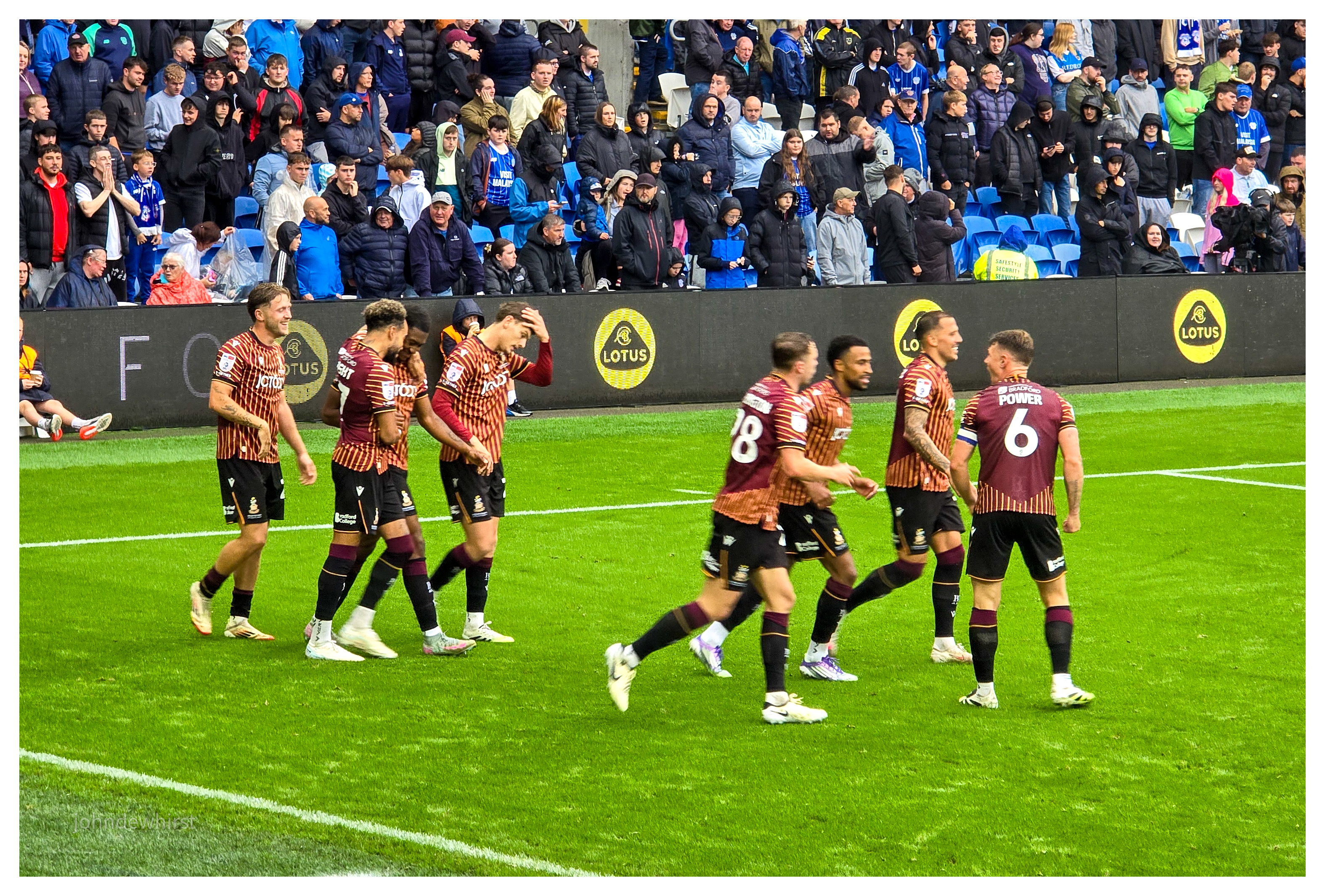
The players have been magnificent
So the manager has a plan, and he can call on a well-oiled recruitment team to help him find what he needs. A big part of the strategy is focusing on each player’s character – this is really paying off.
Because there is a clear culture within this City dressing room that is embodied by those who go out onto the field. Right from the first day of this season, players have stepped up to the tougher challenges and delivered a series of superb performances.
Our home record is just incredible, and the players have shown that even in tough moments they can handle the expectations of a loud, demanding crowd and perform. Away from Valley Parade – which was an Achilles heel last season – results are proving much better. City currently have the fifth-best away record in the division.
It’s obviously too early for player of the season conversations, but if you had to pick one for the campaign so far, you’d be totally spoilt for choice. Neufville, Touray, Swan, Power, Bobby Pointon, Sam Walker and Antoni Sarcevic probably lead the way. But huge respect to the likes of Tommy Leigh, Aden Baldwin, Tyreik and Joe Wright, Calum Kavanagh, McIntyre, Pennington and Tilt for their displays too.
It sums it all up that Brad Halliday – such a big player for the last three years – can’t get the near the starting line-up. Halliday has done nothing wrong: he’s just a victim of the rising tide. Andy Cook, so pivotal to City since 2021, is going to find it hard to regain a regular starting role. Lewis Richards can barely get a game. Neill Byrne, Ciaran Kelly, George Lapslie are no one’s idea of first choice starters but are showing their quality. Alex Pattison continues to do well when injuries don’t strike. Humphrys had a slower start than others, but his quality is undeniable.
It’s a mighty squad that are displaying commendable levels of consistency, character and commitment. They are everything you want Bradford City to be. And we love them for it.

The club are getting it so, so right off the field
I turn up to watch these widely popular players using a season ticket in the Main Stand. Visiting the concourse before kick off is quite the experience these days. You have a team of greeters on hand to welcome families. Balloons and stickers are handed out. In one corner you’ll find a computer games hub. Another space features a dedicated Billy Bantam area for kids’ activities. There’s a DJ playing tunes. There are huge murals decking the walls. And it’s noticeable how full the place gets even an hour before kick off. This wasn’t the case before.
The club have transformed the Valley Parade matchday experience into something that’s about more than just the football. You see it in these and other neat small touches all over the place. From the new signage on top of the Kop to the giant banner unfurled from the upper tier balcony for certain games. The carefully planned pre-match song repertoire and the encouragement of waving flags.
We’ve got new seats, self-serve beer in the Midland Road stand, and for the first time in 25 years we’re actually having serious supporter debates about how we’re going to need a bigger stadium – such is the demand for tickets.
There’s just so many nice touches everywhere you look. The club oozes a feeling of being well-run. And so it’s time we gave some long overdue credit to the guy overseeing all of this.
Ryan Sparks was a deeply unpopular figure two years ago and deservedly so. The club was not well run, and at times his public statements were tone deaf. But he’s absorbed the knocks, kept faith in what he was trying to achieve, and he’s ultimately developed a structure for the club that is paying off.
There was a danger, based on past form, that May’s promotion success would go to Sparks’ head. That he’d make it all about him. But aside from the odd summer podcast self-brag appearance, Sparks has quietly used the Sarcevic 90+6 triumph as a platform to make the club even stronger. From persuading Rupp to up the budget to the many small incremental improvements you can visibly see across the club.
Sparks has had his critics. But lessons have clearly been learned and put to good use. He should be really proud of what he is building, and especially the way he’s going about it.
Whilst we’re praising the CEO, we also need to add in the chairman Rupp. Again, lots of criticism in recent years – again, lots of it merited. I suppose if you go back 18 months and ponder what we wanted from Rupp, it was for him to provide greater financial backing, demonstrate keener engagement, display acumen in entrusting the right people with the day-to-day running of the club, and to offer up a vision of a brighter future.
I think we can rightly say Rupp is giving us all of these and more. And though there is always more to do (training ground/Valley Parade future) and more to still ask of him (more communication would still be appreciated), Rupp is proving to be a decent, honourable person. And he’s showing he can be a successful Bradford City owner after all.

League One is tough, but not in the way we expected
Part of Rupp’s resurgence in supporter approval stems from investing in bigger playing budgets. Not least during the close season, where he was persuaded by Sparks to increase the resources available – in expectation of how difficult League One was going to be.
Along the way, we supporters were treated to some not-exactly-subtle pieces in the T&A about how much of a challenge it might prove just to stay up. How the division’s finances had grown since last time we were in it. “The mini-Championship” was how George Lapslie put it.
What were we so afraid of? What looked to be a tough start to the season proved anything but, as City collected all manner of scalps and rushed to the top of the table. It begs the question – did we overestimate how difficult the division would be?
Three things to mention on that. The first is that the respect City paid towards entering this new level manifested itself into superb preparation. We’ve talked about the manager, the recruitment, the players and off the field approach – the success of all of these has set us up to so far thrive in this new environment. So if we did over-estimate the strength of the league, well it’s not exactly proving to be a bad thing, is it?
The second is that the top of League One clearly isn’t as scary as it looked. On the opening day, play off semi finalists Wycombe looked utterly naive. Parachute payment-backed Luton have spent money, but it hasn’t gone on building a team that could live with our press.
Huddersfield’s Lee Grant might know Northern football, but not how to stop our version of it. Cardiff have looked good, yet City completely showed them up. Our tougher games have actually come against less-fancied sides like Wimbledon and Doncaster.
Ultimately, we can say that League One is home to an eclectic bunch of clubs. But the seemingly mightier outfits like Luton and Huddersfield are not playing at this level because they’re well run – it’s actually the opposite. So we watch them make dismal managerial appointments and questionable signings. We make hay when we play them, preying on their delusions of grandeur and how – like us for many years in League Two – they haven’t woken up to the reality of their surroundings.
But that leaves us to the third point – because if the ceiling of League One isn’t as high as it seemed, the floor probably is definitely strong. Right now, the bottom four is made up of the much-hyped Peterborough, big-spending Blackpool, recently relegated Plymouth, and Port Vale. Not too far above them, Wigan, Reading, Wycombe, Rotherham and Leyton Orient can’t fully get going.
Recently the Exeter manager Gary Caldwell reflected on the League One landscape by revealing. “The league is progressing at a rate that’s much quicker than how we are progressing as a football club in terms of finances and that gap is widening every year…So whilst we are staying in the league, actually the league’s becoming tougher rather than easier.”
As warned during the summer, there is very evidently a big gap between League Two and League One – but perhaps not that big of a gap between the top and bottom of this division. It all means we’re prospering at a time when a lot of more fancied teams are trailing in our wake.

The vibes are so, so strong
A quick personal history: my first Bradford City game was 1 November 1997 – so almost exactly 28 years ago. I’ve seen City play in all four divisions and face 90 of the other 91 clubs currently in the league. Some good times, some not so good times. Some huge achievements, some huge let downs.
Based on my own personal perspectives, I would argue that we’re experiencing some of the very best times I’ve seen as a Bradford City supporter. We’re in this wonderful moment of watching the team achieve so much success – especially at home – against the backdrop of little expectation. That’s a combination we don’t encounter very often.
Before a ball was kicked this season, we had no idea what the players could achieve – so none of us were demanding a promotion push. To be where we are right now is amazing. What makes it even more special is we’re yet to attach any significant meaning to our league position. We’re living a care-free existence of just enjoying it for what it is.
That will soon change, and that’s when the feelgood factor might not remain quite as strong as it is right now, even if the success continues.
Because if City carry on like this, eventually we’re going to have to start placing expectations and hopes on it. A place in the Championship next season? That sounds wonderful. But as soon as you dream it might actually happen, you give yourself something to cling onto2.
It’s why we should soak up every feelgood moment right now. It’s so uplifting to turn up on a matchday and watch this wonderful group of players perform in the way they are. It’s so lovely to be part of spellbinding atmospheres, where we cheer every pass, tackle and shot – and where no one has any serious gripe with any player or any aspect of how the club is run. We are top of the vibes league in the country right now. No set of fans is surely having this much fun.
But it won’t last forever, because the history of football everywhere shows it cannot. So at some stage, City will either stop being as successful as they are now, or they start building serious expectations. And whichever way it goes, this current feeling of giddy excitement will start to fade. It will feel more important, more pressured.
Famously in The Office (American version), the character Andy states, “I wish there was a way to know you’re in the good old days, before you’ve actually left them.” Valued reader, these are the good old days. Make sure you’re savouring them.
- Imagine how City would have coped in 1998/99 had Lee Mills got injured mid-season, or what City would have done in 2012/13 if Nahki Wells had done his ACL. What Alexnader achieved last season without top scorer Andy Cook was astonishing. ↩︎
- I’d rank my best season as a City supporter as 1998/99 – the year we got promoted to the Premier League. That was amazing for so many reasons, but by late January – when it became clear we had a chance of achieving automatic promotion – the delight was tempered by anxiety and fear. We were so desperate to finish the job and claim the biggest of prizes. And whilst it was still utterly thrilling to go through that end to the season, it also became utterly terrifying. ↩︎
Categories: Opinion
 Has this season been a success?
  Anger, Atmosphere, Advantage: Why Saturday saw Valley Parade at its finest
  Tyreik is getting it (W)right
  We always win at home, but never away
  widthofapost.com
totally agree except for one point
we were talking about needing a bigger ground in 2016 before rahic began his madness
all Rupp has really done so far is restore us to 9 years ago
hopefully there is more to come
next year div 1 looks tough to escape If sheff u sheff w and Norwich come down
So very true.
City have yet to achieve anything of note under Rupp’s ownership.
its all been downhill since 1911!
Thanks, Jason.
Which is the club you haven’t seen City play?
Fulham
Super article, by the way.
City last played Fulham in 1987/8. Including watching on tv, I miss out only on Fulham, Wycombe, and possibly Palace.
Sorry John, the last time Coty played Fulham was 13.4.1994 in D2 at Valley Parade. 0-0 draw. 5015 in attendance.
For once, I’ll do a brief comment… Great Article Jason!
Graham Alexander is key to the good vibes – the club must continue to do everything it can to help him (and keep him)
Steven Gent is not a great scout of players his past performance under Hughes and Adams proves this.
Worth adding that Gent was not at the club when Adams was manager.
definitely better recruitment since Sharpe turned up
who knows?
Great times I reckon we can go up this year
Great piece. Good to see some credit going to Ryan Sparks. To make all the right decisions, under pretty extreme pressure, and turn round the fortunes of this club so fast, is really impressive. Imagine going to work knowing you having 20,000+ critics of your every decision, plus an army of opinionated typists like me online giving our threpence worth. I can honestly say I wasn’t expecting this. Things were looking very precarious just a few months ago really. Well played sir. And… credit perhaps goes to WOAP for nudging things in the right direction, with the idea of a director of football, for example. Well played everyone! Amazing how football is played out, not just by the players, but by the whole club.