
By Peter Rowe
The name Erik Regtop springs to mind in the summer of 1996.
Not because he joined City in the July, but that he left so swiftly two months later.
Regtop was an attacking midfielder who joined from Dutch side Heerenveen and I think we were all surprised when he just disappeared back to Europe, to Swiss side St Gallen.
The reason? His wife hated Bradford. Not the club, but the city – she never wanted to be there, so an unhappy wife meant he was not for staying.
Others, who had arrived from overseas did however stay and at one point the club had an array of international talent.
A Swede in Rob Steiner, Norwegian Ole Bjorn Sundgot, Finn Jari Vanhala, Dutchman Marco Sas and Sergio Pinto from Portugal.
And of course Edinho – Brazilian, but also with a Portuguese passport that allowed the club to sign him as we were then in the EU.
It was a running joke in the office back at Hall Ings when David Markham announced he was off to interview one of them as to the standard of his language skills, but, as is the case with most Scandinavians (and the Dutch) they all spoke pretty good English.
And when the club announced that Santos would be gracing Valley Parade in a pre-season game thoughts turned to one man – Pele.
Back in 1990 I had the great privilege of having dinner with this icon of football at a hotel in Sydney, Australia. In a one-on-one interview we chatted for about three hours about his career, Brazilian football, Gazza (it was post the Italia 90 World Cup) and ‘that’ save in Mexico in 1970.
I have a personally signed picture on my study wall from that meeting.
So I called the chairman to enquire about the game and was told in no uncertain terms that the great man was indeed going to be there.
Typical ‘salesman’ Geoffrey Richmond. But he was adamant, so we published a story – that probably added a few thousand to the attendance that evening.
Santos won 4-0, with Kammy purring to me about their skills, but as I’m sure you have guessed, no Pele.
From memory I think we received one or two letters from fans asking why Pele had not turned up, to which we diplomatically pointed them in the direction of the chairman’s office at VP.
It was the beginning of an interesting season that would see Kamara depart in the January after a long running feud with the chairman over player signings.
When Richmond criticised Kamara in the club programme at one game, we all felt the writing was on the wall.
I was never in a position to get the wrong side of the chairman at that level. Sure we had disagreements over the odd thing – stadium naming rights was one that I do remember – but it soon blew over and we got on with doing our job.
The club had sold the naming rights of VP to a local radio station – a competing media organisation. So the T&A’s stance was that we would not be promoting their brand. Valley Parade it was.
Geoffrey huffed and puffed over it, but it didn’t last long. He still needed us to help him put bums on seats.
A couple of years later at Wembley Stadium I had a beer with Kammy after the Carling Cup final between Spurs and Leicester City.
He was working then for Sky and I was media director at the Football League.
He didn’t say anything about his departure as I ventured to discuss City, just rolled his eyes. I got the message.
The great escape took place in the first week of May of ’97. A win over Charlton Athletic and then on the final day of the season 3-0 against QPR saw the Bantams stay up. Third from bottom on 48 points.
The off-season had seen the usual comings and goings.
Darren Moore from Doncaster for a shade under two hundred grand was one who would later become another iconic figure.
Even the sports desk at the T&A would chant ‘Bruno Bruno’ after he had put in a man-of-the-match performance. Much to the annoyance of the more sombre business desk next to us.
Another was Jamaican Jamie Lawrence, a midfielder who I think was far better on the wing and Peter Beagrie from Manchester City.
‘Beags’ was a colourful character, always full of confidence and jokes, but his early career at VP saw him go to Everton and back, then Wigan before he finally ended his career at Scunthorpe.
Looking back at the squad now, it did look a bit light, but that season had started so positively and I remember Richmond taking me out to lunch at a smart restaurant in Heaton to discuss the forthcoming campaign.
And an idea I had to improve the ‘experience’ for the working media on match days was given its first airing.
Over a first course of chicken livers and yes, it’s funny how you remember some of the little things, the chairman asked me what he could do to get more ‘positivity’ from the media.
I explained that a decade earlier I had worked in the NFL in the US and had seen how proactive clubs there were with regard to looking after their media on game day.
Hot food, a relaxing room to do their work before and after the game. A beer maybe. The NFL experience for me was five star so I thought, ‘why not’. I told him how it worked over there.
I thought little of it until the first home game of the season when I was escorted to the new media room. A chef carving roast beef, a TV with Sky Sports, a small bar. Freshly brewed coffee.
Wow! This was a major step up. The Sunday Mirror’s correspondent Lindsay Sutton was amazed. He thought all we were going to get was the standard cup of bovril and maybe a sandwich.
“Pete, what’s going on here?, he asked. I told him the story of my lunch with the chairman and how they do things across the pond.
“I wish you’d warned me,” he replied. “I grabbed some fish and chips in town on the way here.”
He didn’t again, as the media room became the talk of reporters – with hopefully more ‘positivity’.
At that lunch Geoffrey was full of optimism and praise for Kamara, but the fortunes of football can turn on a sixpence.
What’s that terrace song? You only sing when you’re winning.
Five months later City weren’t winning, there were brewing disagreements behind the scenes and there was only ever going to be one winner.
But back to the start of the campaign…
13 points from a possible 15 had us discussing the idea of reviving the Saturday evening Pink, as crowds and interest in the club grew.
We did launch ‘Yorkshire Sport’ later in the season, with David Markham phoning in his report to a dedicated copy taker – a lady wearing a headset who typed up David’s words and sent them to me via the newspaper’s internal computer system – after 20 minutes and then at half-time and again with 20 minutes to go.
If something dramatic happened he’d quickly phone again. No laptops then!
The Sport was also used as a circulation tool to boost our ‘official’ reader numbers. By including a percentage of advertising from that Saturday’s paper we could add ‘our’ sales to the total figure.
It was this commercial decision that enabled us to relaunch – albeit for a short few seasons.
The majority of the paper was pre-written with interviews and stories from VP, which kept David Markham very busy.
The back page had the classified results and all the tables, the front the image of the day with the headline story and pages two and three for the reports, which included those ‘other’ clubs we had to cover!
Deeper inside we also previewed other local sport – the Bulls if they were playing on a Sunday.
Our photographers had taken first half images so I had maybe six or seven pictures to choose from – hopefully a goal and a celebration – known as a ‘Jubo shot’ – short for jubilation.
By the 75th minute mark we had the headline written, the pictures placed and David’s early story on the page.
I also had a dummy page set up as an alternative, in case the result changed because our editing time once the final whistle had gone was about 30 minutes, maybe less. We were on the press at about 5.20pm. It was that quick and often that hectic.
If all went to plan, all we needed on the whistle was what is termed a ‘top’ to the story. That introduction paragraph that led the story, City lose, or City win or another talking point from the game.
Headline, sub headline, David’s byline, the intro, copy, image or images and captions explaining who was in the picture.
The same for the inside pages – and our small team of three or four in the office had done their job.
Off to the pressroom and on the evening of that first edition, I grabbed a bundle of papers and made my way to VP and the boardroom, where Geoffrey Richmond greeted me and congratulated us on our achievement.
The Saturday sport supplements around the country were great, but hard work and you had to be ready for anything in order to make the deadline.
I’d learnt the art of managing that process at the Sunday Express in London on Saturday evenings prior to moving north. There we worked our way through 13 different editions from 5pm until about 10 in the evening, moving stories and images and rewriting reports from all the games.
A Manchester United versus Chelsea report would start out with an even stance then switch to become a United view for a northern edition before switching back to a Chelsea viewpoint – with added post match quotes for the final run, which was London. All the same initial report, just carefully crafted and rewritten to suit the edition’s geographic destination.
The Monday paper was different. It would carry the after match reaction, with David often at the club late interviewing players and coaches before appearing in the office on Sunday morning or early afternoon to write it all up.
Covering a professional club on a regional daily newspaper was a seven day a week operation and none of us did it for the money.
The paper’s news team would jump in for special occasions, the Queen’s visit to open the new stand was one such event and the annual Bradford Fire remembrance service another – the latter treated with great reverence. And quite rightly so.
The T&A at that time had a library of images, prints and film, dating back decades. It was before digitalisation.
And the images taken years before of that tragic day were kept in a locked box in that library. Not to be used without express permission.
We would often get a call from another media organisation after a picture of that day and the answer was always ‘no’.
David had been at the club that day reporting the game. So were his two sons and his father. For over an hour afterwards he didn’t know of their whereabouts. It affected everyone.
I digress, so back to that season.
Kamara had used 42 players in the 1996–97 campaign to avoid relegation and by December of the new season relationships definitely looked strained at the club.
So it came as no surprise really when Richmond sacked him after an FA Cup loss at Maine Road.
Kammy had wanted funds to bolster his squad, money was tight and the rest is history.
What followed was a bit of a surprise though.
David informed me that Joe Royle was in the frame, but I suspect Joe wanted funds as well, although his old club Man City were also sniffing around and he eventually went there.
Then there was the strange tale of former Liverpool defender Barry Venison, who apparently just didn’t turn up for an interview.
Which, I suspect, left Richmond with very few options.
Step up one Paul Jewell, who was Kammy’s assistant.
‘Jagger’ knew what he was getting into, but saw it as a chance to prove himself.
In his 21 games in charge, Jewell won six games and drew five to guide Bradford to 13th.
While all of us expected a big name, Jewell won the day and was rewarded with a permanent contract at season’s end.
The gamble for Richmond, who by now had a reputation of being a hands-on hard bargaining chairman, had paid off.
By the time the 1998-99 season rolled around I had already left the sport desk, and after a year at the RFL as media manager was ‘headhunted’ to join the Football League as their Director of Communications. A position Geoffrey Richmond, by now a non-executive director at the league, helped me get.
And as part of my job every weekend I would attend a game. Plus a midweek fixture. Over a thousand miles a week traversing motorways from Yorkshire to London to the League’s administration office in Preston.
In our London office, on a floor we rented from the Premier League, I and our marketing director Brian Phillpotts and chief executive Richard Scudamore would organise which game every week we would be at. Meeting and greeting and observing clubs in action.
I was even sent to a couple of clubs to listen in on possible breaches of league regulations.
“Just stand around in the boardroom, shake a few hands, small talk and listen,” I was told.
Hull City at the time was one such club and I sat in the boardroom at Ninian Park listening to visiting directors discuss their business options. I then reported back my findings via mobile phone to the chief executive as I drove back across the Severn Bridge later that evening.
It was an interesting by-product of the job.
But mostly that season it was City, home and often away and after a few weeks they quickly figured out where I was going.
I was still living in Shipley so it was a simple choice when City were at home and I was always made welcome in the boardroom as the stadium changed its shape.
For that season the director’s box was in the corner of the ground and at one game I sat next to Kevin Keegan.
My wife wasn’t impressed as she had initially been sat next to him. I had to use the gentle art of persuasion to get her to switch seats so I could have a chat with the England legend.
That season Richmond did open his cheque book and we saw an influx of players – Isaiah Rankin from Arsenal and Lee Mills just two.
But the biggest by far was return of the ‘prodigal son’ Stuart McCall.
His time was up at Rangers and nearly ten years to the day he came home – after a call from Jewell to ‘sell’ him the club.
They didn’t have to do that as McCall knew what he was getting and my recollection of that time was that the chairman was in awe.
As far as Geoffrey was concerned Stuart walked on water!
It is interesting to note here that Huddersfield were also interested. McCall was friends with Town’s Peter Jackson – but the lure of VP was too much.
McCall was seen as the last piece of the jigsaw, although at the time I doubt many thought City would be promoted.
And David Markham had a great relationship with Stuart that had begun a decade before.
McCall captained the side and although they lost four of their first six games, a 2-2 draw at home to Sheffield United saw them go on a five-match unbeaten run.
A blip at Grimsby then another five matches unbeaten.
Grimsby was a strange place to visit. You would sit in a director’s box that was higher than the stand on the opposite side of the field – and watch a ship traversing the Humber above the stand’s roofline.
It was also where I was told about football’s most bizarre win bonus scheme.
On a sports panel one Sunday morning at a Society of Editor’s conference in Portsmouth to discuss football and the media fellow panellist Lawrie McMenemy told me a box of fresh fish would arrive on his desk after a win when he was manager there.
Most will forget the 2-1 loss at Huddersfield (do we ever forget losing to them?) or the 3-0 defeat at QPR the following week, because just one loss (at Birmingham and I was there) was the only black mark until March.
I didn’t get to every game although I did arrive late at Port Vale midweek, after an accident on the M6 had slowed my journey, to see a 1-1 draw. Vale were rebuilding their stand and the ‘directors box’ was a Portacabin on stilts, where Geoffrey was getting excited about the prospect of maybe reaching the playoffs.
Dean Windass joining in the March, as the promotion push took shape, was another masterstroke.
Windass’ transfer deal from Oxford United had a promotion clause so upon promotion City had to pay Oxford another £50,000 to take the deal to £1 million and he became City’s third million pound signing of the season.
From memory City’s player salary budget that promotion season was about £7 million – small change today for a promotion push from the Championship.
And so to the final three games of the 1998-99 season – QPR away, Oxford United at home and Wolves on the final day of the season.
3-1 then a frustrating goalless draw against Oxford saw all roads lead to Wolverhampton.
The week before I was part of a Football League presentation team at Cambridge United and in the days leading up to the game everyone in the London office knew where I was going to be.
I had only recently moved south to Oxford, but travelled to Molineux with my wife. The director’s box was full so we sat in an adjacent overflow seating area.
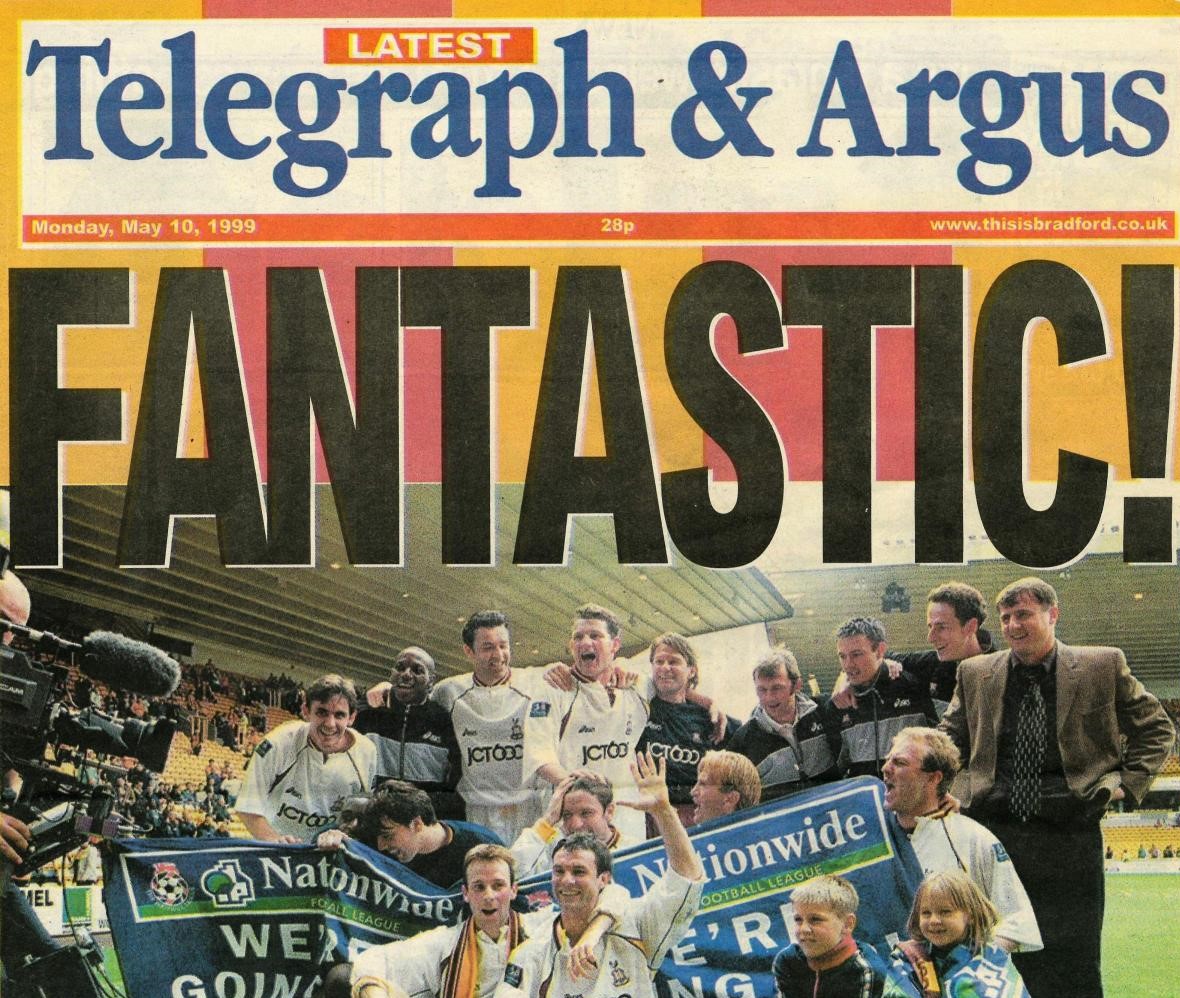
Every City fan of that era remembers that day – Beagrie, Mills and Blake – promotion. I won’t bore you with a running commentary of the game, suffice to say we leapt into the air on the whistle and I was invited down to the dressing room by Shaun Harvey.
It was bedlam, pure joy – tears of joy.
“Are you coming back to the club for the party?” Richmond enquired.
I think you can guess the answer. But first I had to find my wife who I had left in the boardroom. (Women were not allowed in the dressing rooms).
“We will never see this again,” she said to me. “Let’s do it.”
It would mean a two-hour drive at least back to Valley Parade and a three-hour journey back to our Oxfordshire home afterwards.
We arrived ahead of the team bus sometime between seven and eight, drove past the masses of claret and amber outside the ground and through the wrought iron gates into the club car park.
Those images of the team’s arrival you can find on YouTube still, including an inebriated Stuart McCall dancing on and then falling off the roof of a parked vehicle.
No injuries, he just got up and carried on.
There was an open bar and Geoffrey was holding court – an amazing, amazing evening.
We arrived home many, many hours later – tired but so glad we had made the decision to take up the invitation.
I watched Manchester United’s epic Champions League final comeback against Bayern Munich with Geoffrey Richmond at a big bank function a few weeks later in the City of London.
He never told me, but I guessed he was looking for investment to fund the Premier League dream.
I only managed to see a handful of Premier League games that following season and after having left the Football League, was soon back in the game as chief executive of Swindon Town.
And my high and low lights?
Or the oddest? That’s easy to start with.
Being sent to a Whitehall meeting of faceless bureaucrats when they wanted all Football League clubs to wear silly hats to promote a health campaign – in June.
The conversation ended abruptly when I had to explain (much to my shock at their lack of knowledge) that footballers are on holiday in June – there’s no players at a club at that time of year.
Lots of great people working, planning selling advertising and sponsorship, prawn sandwiches and the like, but no players.
And being an ageing Sir Stanley Matthews aid at the Centenary dinner of the Football League’s 100th season and then watching on as a former England star, who I have mentioned before when he visited Valley Parade, was swiftly ushered off to bed after trying to physically assault a coach – and I then managed to keep it from the media for many months.
We’d built a stage at the Hilton on Park Lane with a tunnel entrance on to it – which meant a long walk around the back of the auditorium to the kitchens and then through a door behind the sous chef – yes it was bizarre – in to the tunnel and on to the stage.
Everyone thought Matthews was an ‘awkward sod’ and no one wanted to be his escort. It didn’t bother me. As we walked we were approached by another Blackpool and England legend, Jimmy Armfield.
The pair shook hands and as we walked way Sir Stanley whispered in my ear ‘No left foot’.
Being a club CEO was a personal high – what an honour – but seven days a week and exhausting.
Signing a talented young player who had gone off the rails for a £60 petrol receipt and two motorway service station breakfasts when his ‘agent’ wanted a £20,000 fee.
Talking to and meeting so many names in the game, attending footballer of the year dinners – I was sat two seats from winner David Ginola as two Spurs legends, Dave Mackay and Clive Allen, asked me to get his autograph for them!
My wife even asked the same when I called her to tell her where I was that evening.
Trying to manage Neil Razor Ruddock at Swindon – we became great friends – was another very interesting time.
And sharing an office with Liverpool legend Roy Evans when there. An absolute gent. He had my back and I his.
One freezing cold day at the County Ground he introduced me to Joe Jordan, who was Lou Macari’s No. 2 at Huddersfield at time, I’m pretty sure. We had a pitch inspection and the ground was frozen.
Walking out on to the pitch, Roy introduced me to Joe as ‘one of us’. That’s when you know you have been accepted.
Likewise with one Graham Taylor after his Watford had won the first division playoff final.
I was trying to escort him to the press conference after the game.
There’s a doorway halfway down the old Wembley tunnel that leads up to what was the original medical room, now the press room.
We got to the top of the tunnel and Graham stopped. He looked at me and asked if I would give him a minute to savour the atmosphere.
Here was a man who had just got Watford promoted. How could I refuse.
We stood there together for a minute, maybe two as Graham took the applause.
He then put his hand on my shoulder and said “Thank you. You don’t get this every day,” And we headed off to face the press.
And finally, why I walked away from the game, being sued for £1 million as warring club directors went head-to-head in the High Court over Ruddock’s contract.
A judge threw it out as a complete waste of time (and it was) but it was six months of hell.
Awarded all costs but it showed me a dark side of the game, where I was even pushed against a wall and told to go on gardening leave when all I was doing was my job, that left scars for a very long time.
It now seems like a lifetime ago, but I always look out for Bradford City results from my home in Australia – where I have lived since 2003.
And I’m dismayed at how far the club has fallen from those rollercoaster days of the late 90s.
I was both interested and concerned to read of the lack boardroom leadership at City, with an ‘absent owner’ leaving everything in the hands of one person. Well that’s how it looks.
I remember Alan Biggin from my time visiting VP and know him to be an honourable man and a fervent City supporter. I don’t know Mr Sparks, although his resume looks a little lightweight when it comes to managing a potential multi-million pound business.
But to drag the club out of the fourth tier and back up the football pyramid requires investment and entrepreneurial leadership, something I am not sure the current CEO has.
I suspect he’s there doing a job and facing a day-to-day firefighting exercise to keep the club afloat.
I say that from personal experience when I had that role at another then League One club and I can assure you it ain’t easy. Far from it.
And fans in the boardroom is another issue that often worries me. Why?
Because fans are emotional – quite rightly so – and the boardroom often has to divorce itself from that level of emotion and work on business logic. Getting the right blend is a road littered with failure. No easy fix at all.
City should be a club in the Championship – it has the fan base and a stadium to match that level, but to get there will require long-term commitment in terms of investment and a team of people led by experience and dare I say, a bit of ‘risk flare’.
Someone or a team that is prepared to take a gamble when the option is there for the good of the club. I can’t say I can see that at Valley Parade today.
And, quality investment that is in it for the long haul – a strategic plan that shows a pathway that attracts ongoing support as the club climbs the league.
The boardroom has to lead and empower its executives, chief executive, manager and senior staff to do their jobs.
Without that leadership there is little chance of success. Just look at the current issues at Glasgow Rangers where the lack of any leadership in their boardroom has seen their bitter rivals Celtic dominate.
Staying solvent is not bad, it’s the basis of any good business. But football isn’t just ‘any’ business.
Working in and around football for many years I have seen boardrooms that work and boardrooms that don’t.
Very functional ones that know how to both manage and delegate and others that are run by megalomaniacs.
Some with boards so weak the executive feel they are adrift in a small boat, rudderless.
City right now to supporters are a mixture of the staying afloat sort, going nowhere.
To go somewhere, and I’m not talking about going down – or out of business, God forbid, you have to ask Mr Rupp if he has a strategic plan – or does he want to sell, or look for new investment.
At least one of the above will give us a clue.
I suspect that right now he is trying to stem the flow of money into what seems a bottomless pit. I bet he’s even wondered why he stepped forward in the first place.
And after copping a level of criticism no other walk of life (apart from being an MP) comes anywhere close to, sometimes it’s best to walk away.
City fans are loyal and patient, but patience doesn’t last forever.
Categories: Opinion
 Bradford City’s 3-4-3 puzzle: Success without a goalscoring striker
  Has this season been a success?
  Anger, Atmosphere, Advantage: Why Saturday saw Valley Parade at its finest
  Tyreik is getting it (W)right
  widthofapost.com
Interesting read Peter.
And here lies the problem: “I was both interested and concerned to read of the lack boardroom leadership at City, with an ‘absent owner’ leaving everything in the hands of one person. Well that’s how it looks. But to drag the club out of the fourth tier and back up the football pyramid requires investment and entrepreneurial leadership, something I am not sure the current CEO has”.
More than a few previous managers say there is something wrong/rotten but won’t say what it is. I suggest, as you do, that just about everybody – (except Rupp) can see this as the problem. Yet he won’t thank Sparks for his efforts and dispense of his services, (although he is meeting targets of “sustainable”),and line up a proper CEO (Sharpe??). Surely there cannot be many clubs, if at all, with a board consisting of an absent owner (not uncommon I guess), a CEO (so out of his depth) and a part time associate director. Proper companies have a structured board with expertise in their own given area, formulating plans etc. We just seem to be winging it more in hope than anything else. How should Rupp go about creating a proper board though if nobody comes forward? Firstly seek a new CEO with a good football background and not a lowly rugby league club. Could this be the reason nobody wants to join the board as there must be enough wealthy experienced City fans around the district that could foresee the potential of the club.
Thanks Gerry – and som e fair points you make. I suspect there are a few reasonably wealthy and business-savvy City fans out there – but equally perhaps many who have already had their fingers burnt in the past. I have seen that at many clubs. But from where I view the club – I do not see structure, executive leadership or a five-ten year strategic plan that includes investment, recruitment and crucially retention of the right people. Coupled with selling the project to an amazing supporter base eager for success.
enjoyable read
Enjoyable couple of articles
thank you
One of the best WOAP articles I’ve read. A shame the author Peter Rowe isn’t on our board of directors, he’s got the experience we’re sadly missing.
thanks for your comment. such a shame to see City languishing in the fourth tier. Football these days is a much different beast to what it was back then – just look at the tiers of regulation. with potentially more to come from government, the money needed to build a squad to challenge on the field, and the management of the stadium. And I haven’t touched on the most important factor – the fans, the supporter base that so desperately wants success. I have sympathy for the current club management team, but do wonder if it needs a stronger hand at the helm.
Very enjoyable read and some fantastic memories of past players! None more so than one Marco Sas who on our visit to Holland in the inter toto Cup, came in to the bar we was in after we’d played RKC waalwijk and bought us all a drink after the barman told us he knew him and rang him up. Brilliant memories.
I always enjoy reading ‘behind the scene’ articles. This, part1and 2, contribution was a particularly interesting and enjoyable read.
Thank you.