
By Alex Lester
As someone who spends a significant amount of time analysing the stock market, understanding the underlying trend is everything.
At its core, every market move can be viewed through three lenses: the primary trend, which defines the dominant direction over months and years; the secondary trend, which captures the counter-moves and corrections that unfold over weeks to months; and the minor trend, the day-to-day fluctuations that add noise but often hint at shifts in momentum before they appear in the bigger picture.
For Bradford City fans, there’s comfort in knowing that if you zoom out, the trend is unmistakably bullish – far more so than most of us dared imagine at the start of the season.
After securing automatic promotion back in May, City’s rise has felt like a powerful, sustained rally. An epic push higher punctuated by only a handful of minor pullbacks along the way.
But over recent weeks, something under the surface looks to have shifted.
With Andy Cook and Alex Pattison’s departure, bearish rhetoric has grown louder, culminating in a crescendo following the weekend’s 1-0 defeat against those down the road.
Outside of the usual murmurings that surface at this time of year, the stats paint an equally disturbing picture.
On November 8 City held the highest xG per 90 in League One, with an average of 1.59. Today, they sit 5th in the xG standings, having recorded an xG per 90 of just 0.94 over the last 11 league matches – signalling an alarming 40% decline. Add to that, City have now lost more league games in January than they did throughout the entirety of August, September and October combined – again signalling a drop-off that’s difficult to ignore.
So the question has to be asked: are we witnessing a shift in the primary trend, or something as benign as a reversion to the mean in a wider, bullish structure?
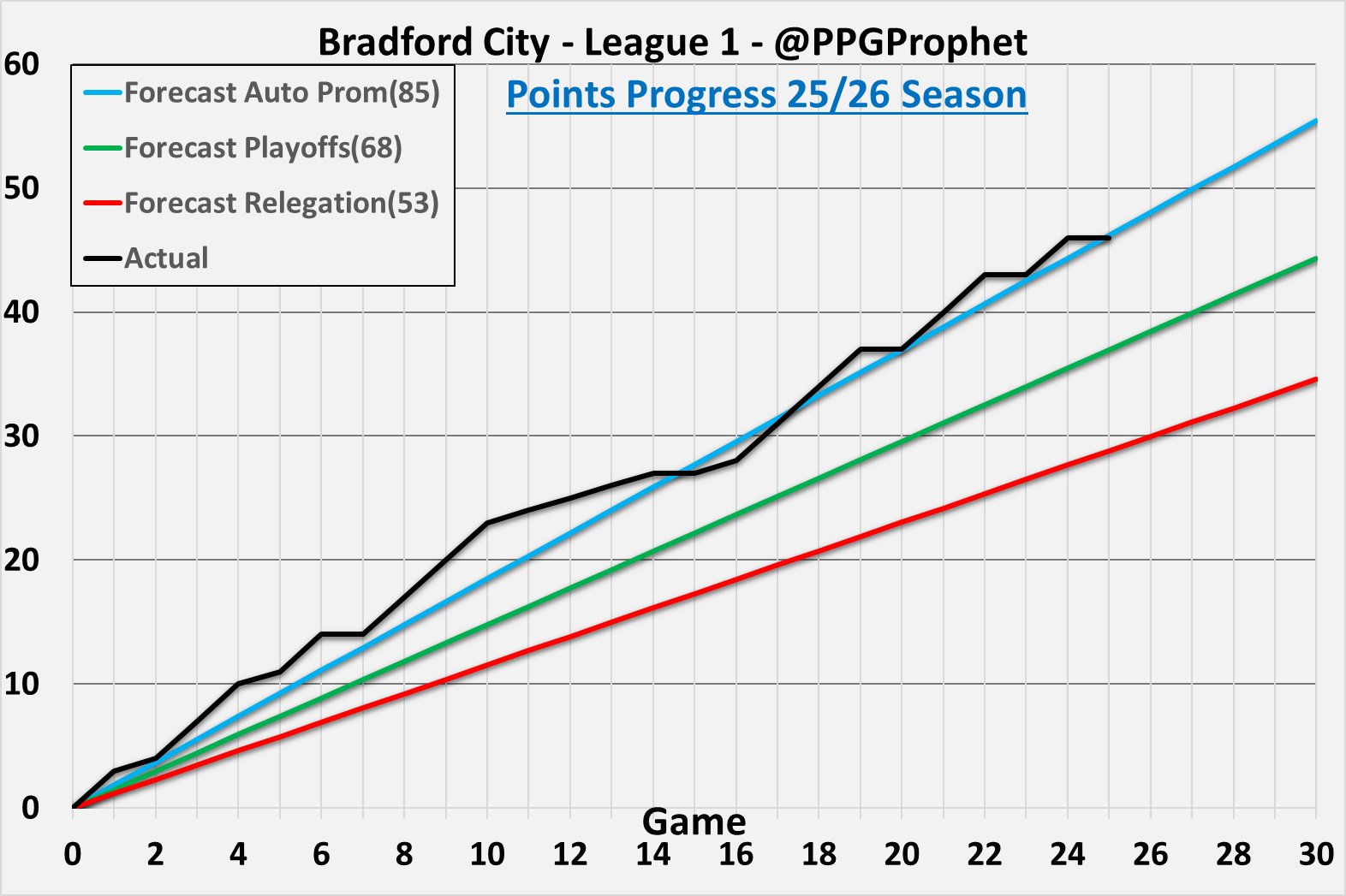
At the time of writing, the trend is still very much ‘up and to the right’, with City on-track to finish the season in the playoff positions on a forward-looking PPG basis. (Source: @ppgprophet)
Should this change over the coming weeks and months, then sure we can start talking about some potential downside – but for now, the trend holds true.
But here’s the thing about trends: they rarely hold up without a catalyst. In market terms, these catalysts typically arrive in the form of earnings, new products, or a shift in the broader narrative.
In football, one of the most powerful catalysts is far simpler – a new face through the door.
Which brings us to the January transfer window.
If the trend is to be defended – or even accelerated – then the market’s next data point matters more than any single result. In City’s case, my view is that the rest of the season won’t be decided by the result at Sincil Bank or at home to Doncaster Rovers, but a decision made by those higher up the club.
And in January, that decision almost always centres around one position.
The number nine.
For the majority of this season, Stephen Humphrys has operated as a lone striker, with Graham Alexander offering little evidence that this is set to change any time soon.
For all the talk of recruitment, the reality is that Humphrys is unlikely to be displaced – making any links to the likes of Jatta or Langstaff feel more like speculation than strategy. Added to that, as arguably City’s highest earner and the club’s marquee signing of the summer, replacing him outright in January would represent a sharp pivot – financially, politically, and tactically – that few clubs at this level are willing to make mid-season.
But that doesn’t mean the position is a closed book.
What recent performances have underlined is that Humphrys isn’t a natural target man. He thrives on movement, channels, and space – not on being the lone reference point with his back to goal. In his current role as a lone striker, we aren’t utilising his talents.
In that context, the more subtle catalyst may not be a headline signing, but a supporting presence. Someone willing to do the work Andy Cook once made his own: winning first contacts, battling for territory, and turning half-chances into goals.
Could Ethan Wheatley be the answer here? Maybe, maybe not.
Were this to play out, the obvious trade-off is structural. Freeing Humphrys from his role as much-maligned target man and introducing a true focal point likely means a shift away from the 5-2-3 that has propelled City into the top four. A narrower 5-3-2 – last seen in League Two – or a variation that replaces two wide forwards with a target man and dual number 10s, potentially Humphrys alongside Sarcevic or Pointon, becomes the alternative.
Were that to play out, City’s reliance on wide players would ease, offering much-needed rotation to an attacking unit that is beginning to look leggy. It would also place greater emphasis on the wing-backs – an area that has quietly strengthened in recent weeks, with two Championship-tested additions now pushing Ibou Touray and Josh Neufville for starting roles.
This is where the season’s next inflection point likely sits, in my view at least.
Sure, I’d love to be proved wrong and would welcome Jatta or Langstaff through the door were they to join. I see the points being made about taking advantage of the momentum we currently have and don’t disagree with the sentiment – but given Rupp’s record as an owner and the club’s recent history when it comes to the January market, I’m struggling to see a situation in which we go ‘all in’.
Which means the real catalyst this season may not arrive in the form of a headline signing, but in how City choose to optimise what’s already on the pitch – the same players that not only propelled us out of League Two in the first place, but also cemented us a force to be reckoned with in League One.
Because despite the recent noise, we really ought to be pinching ourselves. Zoom out, and City remain firmly in an upward channel – competitive, positioned, and very much in control of their own path toward the business end of the season.
Corrections happen. Momentum ebbs. Sentiment swings.
But until the underlying structure breaks, I remain firmly in the bullish camp.
Categories: Opinion
 Bradford City’s 3-4-3 puzzle: Success without a goalscoring striker
  Has this season been a success?
  Anger, Atmosphere, Advantage: Why Saturday saw Valley Parade at its finest
  Tyreik is getting it (W)right
  widthofapost.com
I remember Windass struggling to score goals on his return in the mid-2000’s, until we got loans like Wilbraham and Adebola on loan.
Once they started doing the donkey-work it unburdened Windass and he couldn’t stop scoring.
it will be a very disappointing window if we only get Wheatley. We need better for the playoffs and much better for automatic
the outgoings have been right – now let’s get some good stuff in through the doors
The manager needs to swallow his pride and admit that playing Humphries as a number 9 was a mistake. I’ve seen nothing in half a season to suggest he can do this job. We’re wasting a good player in the wrong position it! Why can’t managers just admit when they’re wrong and change? Surely he can see what every fan can see, it’s not working!
“The definition of insanity is doing the same thing over and over and expecting different results”
pointon needs to play in the 10 position he will create chances and score goals,centre forward needed as soon as possible Humphrey’s given freedom on left or right .Big mistake to let Cookie go to Grimsby without a like for like replacement, G A was quoted as saying we do not play Hoofball any more that’s why he did not play Cookie, Let me say that is exactly what the team is doing . Too many changes to the team and no plan B .Last few games first half we have been outplayed would like to see extra man in midfield then we might compete Still in there with 20 games to go all to play for I still believe in top six we can do it.
Speaking of new recruits, anyone know what’s happening with the heritage player numbers. I looked on the website yesterday and its a couple of seasons behind?
Thanks Alex, enjoyable read and good to get a view from somebody with your professional skillset. It’s made me feel rather more upbeat that I was because…
… now, massive caveat – the window isn’t over yet, and it’s not fair of me to pass judgment on something that is still unfolding. But if I was going to do that…
I’d say that the club have decided to focus on a squad rebuild in the Summer.
This is just my read, but the only way of making sense of where we are today (*see caveat) is if we are taking the rest of this season as a ‘free hit’ because the primary trend dictates the narrative. Say the downward trend continues and we finish just inside / outside the playoffs. That’s a massive over-achievement on what everyone anticipated in August.
So the saying goes, it’s hard to do good business in January. So what you can do is offload those who are – for whatever reason – now seen by the staff to be surplus to the grander plan, and be ready to recruit stronger / better players in the Summer when the market is more favourable (especially for strikers).
I hope I’m wrong, because it’s a huge gamble to pass up this opportunity to go ‘all in’ given our league position. But like Alex, that just doesn’t feel like ‘us’ – even this much-improved version of ‘us’ – and so coming out of this January window “weaker” makes some sense if the strategy is to plan longer term for having another go next season with a squad that might be considered more “Championship-ready”.
Who knows. I’m loving this season. And enjoying being proud of my club again. It feels brilliant to be a Bantam right now. But adding to the day-to-day noise of the micro trend, I’m struggling to see how what the club has done so far makes sense unless it’s a detached and dispassionate assessment of which window makes us stronger in the medium-term.
I think they’ve chosen the Summer. But they have 7 days left to prove me (hopefully) very wrong!
I like this article. Thank you. In terms of factors affecting variance over time I reflect on handling pressure of expectation or impact of wanting it / focus captured by goal. Not sure what level of trend that drives. The middle one I guess. Maybe exceeding expectation so massively was fine whilst it was a bonus but a millstone once players, club, support get sucked into we “should” go up, it’s our “one only chance”. Like me at Risk if I can see I might win. I start to shake I kid you not…
So I am still as happy as pie we’ve got 46 points already – at or close to what keeps us up. Before the season I’d have taken 20th so I am laughing like a drain now.
I’ve had more than one bottom teir stint, the one before we climbed up to the Prem, the one in between before Parkinson era and this last one.
It is NOT easy to get up and stay up and I for one will “love it”.
By all means lets have a totally committed nothing to lose tilt at the season and see where get.
But getting entitled or expecting?
Nah. Not for me. Recipe for misery and might even get in the way.
I sympathise with the desire by many to get promoted this season and recognise if we were not in that conversation come May it might feel like a wasted opportunity. However, when you look at the competitive nature of the championship and finances involved, I can’t help but believe we are not ready to make the upwards leap. Getting beaten every week is no fun. I share the viewpoint of stability this season, with a platform to equip ourselves this summer with suitable bodies to better make the transition.
this is the weakest Division One for years and likely won’t be so weak again for a decade. It would be crazy not to try and take this chance rather than face much tougher upcoming seasons at this level. Division one teams get £2million per season while championship sides get £11million. To all those supporters who possess a crystal ball and can already see City getting beat every week in the championship I suggest that you’re wrong. The extra money and the expertise of Sharpe and Gent should allow us to at least have a stab at putting together a more competitive squad
We can’t compete with the spending power of Luton , Cardiff, Hudds, Bolton and Reading. Those are the guys that are looking at the autos via spending.
We’re with the other 17 clubs that are competing based on being well run and enjoying some fortune. If we were going to spend money on a forward it would have to be a young player with resale value, we could not add an expensive older forward because if we didn’t go up this season, we’d have an older expensive forward with no resale value on the books hurting our chances for next year, and if there was a young forward available that could make an immediate impact, he’d have been bought by one of the big 5…
So we are where we are, well run, a lock to consolidate our position in the league and looking at some loan options that could come good and keep us in the playoff hunt.
Thank you for this article. It does provide some comfort and steadies the nerves a little ahead of the run-in.
My only concern is with the gist of some of these comments. Why is our fandom always so pessimistic about things? I know our club has lingered in Div 3/4 for long periods before but to accept that as the normative is staggering.
I understand the potential bite-and-hold approach that promotion to a higher division might initially entail is daunting and less fun for some supporters, but we won’t get an opportunity to get out of this division like we currently have for a very long time. LG1 is weak, we have a group of players who will put their bodies on the line for the club, the prize money at stake in the Championship will be significantly higher, the stands are packed, and promotion adds the possibility to 1) shop for a new owner group, and 2) innovate in recruitment strategies.
We are a club that should be going in for promotion and, dare I say it, pushing for the top 2. We’ve shown we’re capable of it, and two meaningful signings would have done it in my eyes. The club has begun the painful work of removing players that can’t make it at this or a higher level, so there must be some wiggle room in the budget.
The timing and delays of recruitment is surprising. Why the alleged signing of Wheatley has taken almost a month to finalize is bizarre. Why we haven’t gotten someone else in due to this delay is bizarre. However, getting a forward in now is better late than never. I also think we need a CDM but that’s not even in the discussion.
To summarize, I think we should go for it as a club. If Mr. Rupp wants to leave us where he found us and present the most promising sellable asset in the summer, this was the time to get the stock as high as possible. Trust in GA!
ok, but unless we spent 6-8m we’d still be behind the squad values of Cardiff, Luton, Hudds, maybe getting to par with Bolton and Reading, and generally speaking the more you spend the better you are. So even with that level of investment the autos would be tricky and we do not have that level of investment.
If there is money we can spend that doesn’t require promotion or bust then yes we should be investing but gambling on our early season form and L1 being weak is not the play.
Not pessimistic. Also enjoyed the prem, the promotion, staying up, the history made. I enjoy it all just almost anything more than Bradforsaken League two/division four with its s… pitches, s… teams and s… refs.
I appreciate the general angle of this comment, and the hesitancy to engage in risk that might sacrifice what we currently have. I share these concerns. The basement division is horrendous on a number of levels, and I’d prefer we didn’t risk going back there (or worse!).
The only point I would add is that it will only be harder to get ahead in the coming years. Taking the summer to bed down a truly competitive squad for promotion is likely to cost more if current trends persist and we may still be up against bigger financial clout regardless.
Concerns on funding can also be assuaged by the loan market for now. If we fall short, that can be baked into the terms. Ultimately, longer term, we need a takeover to facilitate bigger plans.