
By Jason McKeown
It took them a while to get their ticket punched, but Bradford City are in. They’ll be part of the end-of-season play-offs, on this – the 40th anniversary of their introduction by the Football League.
It’s such an exciting prospect. Two huge games coming up, and possibly an even bigger one after that. And as Bradford City’s history of play-off appearances shows, whatever lies ahead over the next couple of weeks will be forever remembered.
Let’s take a potted tour of City’s play-off highs and lows, and reflect on why this could be another special time.
Glory

Let’s quickly go through the obvious. Win your two-legged play-off semi-final and you get to go to Wembley. Win there, and you’re promoted. It’s a hell of a way to go up – a communal outpouring of joyous glory at the national stadium.
City have managed it twice, starting with the 1996 third-tier triumph, exactly 30 years ago. The Old Wembley was awash with claret and amber as some 40,000 City fans charged down the M1, vastly outnumbering their Notts County counterparts.
It was no contest on the field either. City scored early through a lovely run and powerful finish from Des Hamilton, and in the second half Mark Stallard made it 2-0. City promoted.
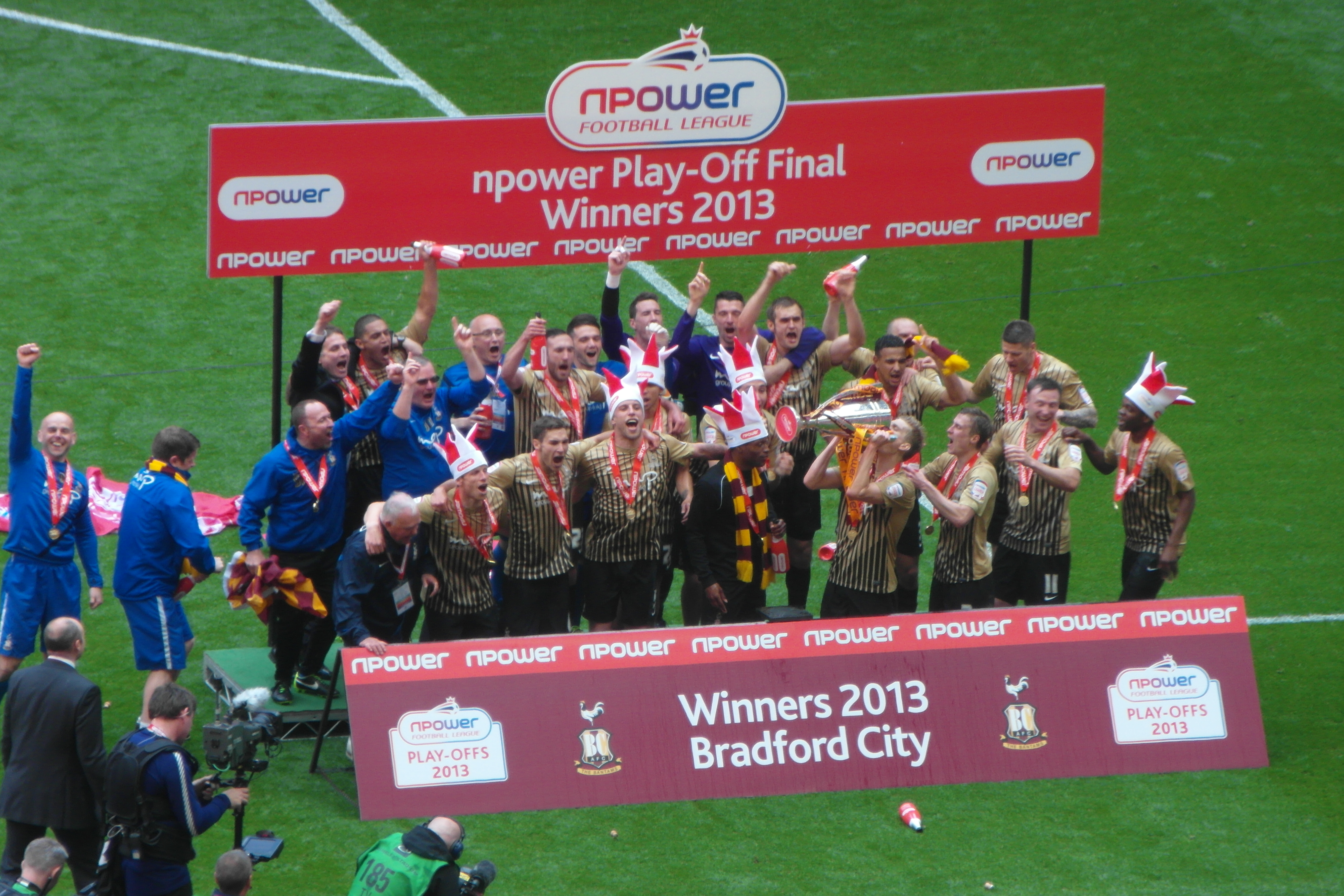
Their New Wembley triumph came in 2013, when City absolutely steamrolled Northampton Town. It was 3-0 inside half an hour, with James Hanson, Rory McArdle and Nahki Wells all on the scoresheet. Cue the most unexpectedly comfortable second half as City saw it out.
What a day that was.
Heartache

Yep, there’s another side to it too. The all-or-nothing stakes mean you can end up engulfed in misery – and City have plenty of scars from losing in the play-offs.
Of their six campaigns, they’ve ultimately lost four. And wow, it can hurt.
Their first dose of pain came in 1988. City were pushing for the top flight for the first time in 66 years, but blew automatic promotion by losing at home to mid-table Ipswich on the final day. Into the play-offs they went, facing a Middlesbrough side managed by Bruce Rioch.
City won the first leg at Valley Parade 2-1 thanks to goals from Karl Goddard and Stuart McCall, but Trevor Senior’s strike kept Boro in it. At Ayresome Park, Bernie Slaven scored to force extra time, and Gary Hamilton completed the turnaround. Boro went on to beat Chelsea to reach the top flight. City licked their wounds.
Millwall have twice been tormentors, in consecutive League One seasons. In 2016, City lost 3-1 at home to the Lions in the first leg and could only muster a 1-1 draw at The Den. Millwall went on to lose the final – but were back a year later, again facing the Bantams.
At Wembley in 2017, a tight, nervy contest was settled by a late Steve Morison goal. And yes, he was offside.
The most recent pain came in 2023 against Carlisle United. City won the first leg 1-0 thanks to Jamie Walker, but a Brad Halliday own goal levelled things in Cumbria. In extra time, Callum Guy made it 2-0, Matty Derbyshire gave City hope, but Ben Barclay settled it. Carlisle went to Wembley – and won.
We’ll come on to that sub later.
There’s a horrible emptiness after play-off defeat.
Everything’s on the line, City come up short, and the ending feels brutally abrupt. As Ian Holloway summarises in the recent Sky Sports documentary about the play-offs, “It’s gone, and it’s so final.”
All that’s left is a long summer of replaying what went wrong, and the reality of starting all over again in the same division.
Psychological warfare

Some of these stories are woven into the club’s DNA. Say “Blackpool 1996” to any City fan and they’ll think of programmes.
City lost the first leg 2-0 at Valley Parade. No team had ever come back from that deficit in the play-offs, so Blackpool understandably felt confident going into the second leg.
But then came the Blackpool programme.
Chris Kamara spotted a full-page advert for coach travel to Wembley – for the final. Blackpool were so sure the job was done, they were already promoting trips.
Kamara pinned copies all over the dressing room.
“I wanted them to see the booking form,” Kamara wrote in his autobiography. “My team talk was virtually done for me. ‘This lot think they’ve reached Wembley,’ I said…It did the trick. They were like wild animals waiting to be unleashed on the Blackpool public.”
City were ferocious. Goals from Carl Shutt, Hamilton and Stallard sealed a stunning 3-0 win.
The Bradford City coaches were heading to Wembley – not Blackpool’s.
Flash forward to 2013, and there’s an urban legend of a similar version to the Blackpool programme. City had again lost a first leg at home – 3-2 to Burton. The story goes that when the City team bus rocked up at the Pirelli Stadium for the second leg, they noticed a sign on the Burton club shop advertising Wembley merchandise. Like in 1996, it fuelled their motivation. City were masterful in coming back to win 3-1 and book a place at Wembley.
Did this really happen? It’s difficult to find any proof out there. But to quote John Ford, “When you have to choose between the truth and the legend, print the legend.”
In the play-off final that year, mind games were definitely at the fore. City had famously reached the League Cup final three months earlier, where Premier League Swansea thrashed them. Ahead of the play-off final, Northampton boss Aidy Boothroyd suggested City would be afflicted by Swansea demons. He could not have been more wrong.
As Phil Parkinson told me when I interviewed him for a book in 2016, “We used the Swansea experience to get us promoted, simple as that. The lads were just so calm, cool and collected on the day. And I was looking at the Northampton players and their staff and they were almost looking starry-eyed at the Wembley surroundings. We’d been there and we’d done it. We were in a good place.”
In 2023, the mind games went the other way.
Ahead of the second leg, Mark Hughes tried to suggest that the larger than usual Brunton Park crowd would hinder their opponents. “They [Carlisle] are going to have a big crowd for the game. They are going to have to deal with that but it is what we are used to week in week out. So it won’t faze us.”
Narrator voice: it did.
Carlisle fans played a part in the psychological warfare too. Word got out which hotel the City team were staying in the night before the game. And so at 3am, a group of supporters set off fireworks right in front of them to spoil a good night’s sleep.
Heroes
The play-offs are where City greats so often cement their reputations.
Who can forget the performance of James Hanson and Nahki Wells at that Burton second leg in 2013. The pair had already had a brilliant season, but on the day were utterly unplayable. Hanson bullied his marker – a certain Anthony O’Connor – and Wells’ runs in behind were devastating.
Wells got the first goal latching onto a Marcus Holness mistake, and then early in the second half Hanson hit a thunderous low shot. Burton pulled one back, but seconds later Hanson caused havoc and Wells bundled home.
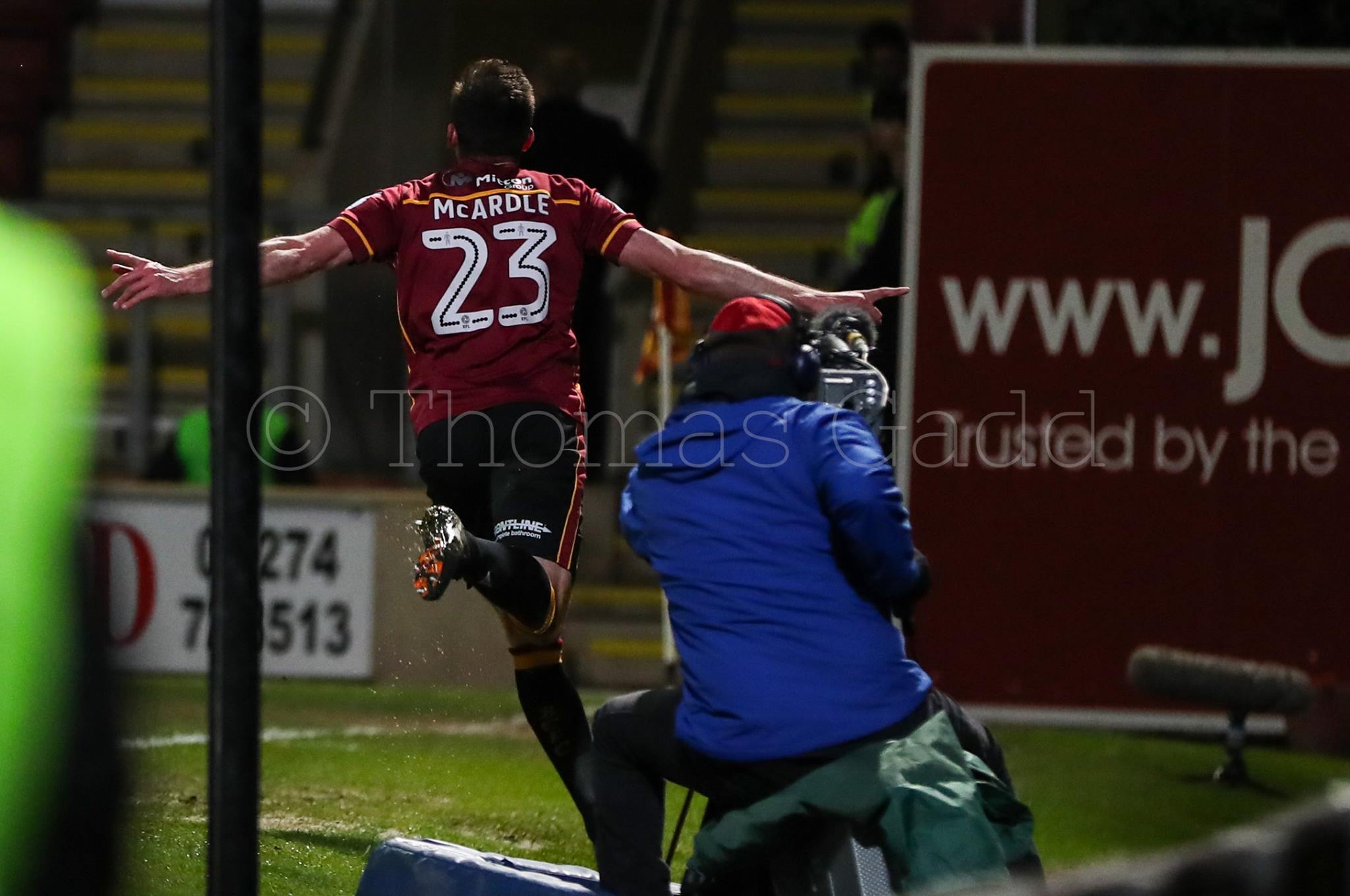
Rory McArdle was part of the City team that day. He would go on to have a couple of his own play-off hero moments. First in that 2013 play-off final, when he got on the end of Nathan Doyle’s cross to make it 2-0 and exhibit his trademark tongue out celebration. And then in 2017 – in what, sadly, would prove to be his last ever Valley Parade appearance as a City player – McArdle headed home a late first leg winner against Fleetwood that would ultimately book City’s play-off final place.
In 1996, the hero story was a little different. It was all about being selfless.
After City’s first leg play-off defeat to Blackpool, a distraught Kamara reflected that the team had resorted to sending too many high balls to Ian Ormondroyd because it was the easy option. He took the decision to leave out the tall striker for the second leg, so the team would be more encouraged to work the ball up to the final third and only send crosses over when they got close to the area.
The goals scored that night were vindication of this approach.
So Ormondroyd was the hero by not playing. And wonderfully he got to have a leading part in the ultimate glory, coming off the bench in the play-off final to set up Stallard to get the promotion-clinching second goal.
Villains
The other side of the coin is the bad guys. Sometimes it’s our own players messing up, often it’s an opponent who excels at our expense.
Calvin Zola in 2013 is one example. The former Tranmere, Crewe and of course Burton man bagged 88 career goals – and it felt like 87 of them came against the Bantams. He always found the back of the net against us, and they were usually bangers too. That included two superb efforts in Burton’s semi-final first leg victory at Valley Parade in 2013.
Other big performers against City include Millwall’s Lee Gregory and Morison, who destroyed City in the 2016 first leg semi-final. Carlisle’s Owen Moxon was outstanding over two legs for Carlisle in 2023.
It’s in that Carlisle tie where Mark Hughes earns his place in the villains too. I told you we’d come back to that sub. Even now, it’s hard to believe it happened. City were struggling badly at Carlisle, but then Scott Banks produced a moment of magic to skin his full back and set up Derbyshire to score.
Momentum is with City! Get the ball to Banks! He’s got the beating of his man!
Then the electronic board goes up.
Central defender Matty Platt on.
Banks off.
What?
City went on to lose. They surrendered their momentum. And when Barclay headed home unmarked, the presence of Platt as an extra defender counted for nowt.
There’s an episode of the Simpsons where Homer is telling his kids about the time he worked in a bowling alley and was trying to devise a marketing strategy to attract more customers. His big idea was to buy a shotgun, shoot it outside the entrance and shout “bowling”. It doesn’t work at all. As Lisa listens to the story she gets frustrated and says to Marge, “Mom, make dad tell the story right.”
To quote Marge’s weary response to Lisa and apply it to Hughes, “That’s what really happened.”
And because it really happened, Hughes’ standing amongst City supporters never recovered.
Who else is a City play-off villain then? Dare we say Tony McMahon?
Stoppage time in the 2017 play-off final at Wembley, City 1-0 down, and McMahon is fed the ball inside the box from an angle. City players are queuing up for a tap in, but McMahon shoots instead of crossing.
It goes behind the goal, and City lose.
Oh Tony.
But the true villains that day were the Millwall fans who invaded the Wembley pitch at full time. And they were the bad guys a year earlier too, for the way they invaded the New Den pitch to goad City fans after winning the play-off semi-final.
Someone should really make them the family club of the year.
Atmosphere
These occasions are special.
The Fleetwood home play-off leg in 2017. Valley Parade a cauldron of noise. A sea of claret and amber. A boisterous Thursday night of chanting and cheering City on to a slender first leg win.
2023 was even better. Unlike Fleetwood, Carlisle brought a huge away following. All four sides of Valley Parade were packed out, generating incredible noise. The second leg at a bustling Brunton Park was a cracking atmosphere too. All in all, 210 minutes of play-off drama played out to the soundtrack of two brilliant sets of supporters.
(Could have been even better without that bloody sub! Argh, don’t start again…Let it go.)
Burton away in 2013 was also a spectacular atmosphere. Fans camped out overnight at Valley Parade to get tickets. The terrace behind the Burton goal, and seating section in the corner, sang their hearts out for the lads. And the scenes of celebration that greeted the Wells and Hanson goals are amongst the most epic I’ve ever experienced.
1,700 City fans went to Blackpool away in 1996. 10 years ago I interviewed author David Pendleton about what it was like to be there. At full time he recalled, “Scenes of utter madness ensued, groups of fans huddled together in almost unbelieving, bouncing, screaming, joy. The celebrations just went on and on, a continuous roar, wild eyed fans went from one to another, hugging and leaping, all the while continuing a mad primeval scream.”
Pure, raw football supporting joy.
Twists and turns

The two-legged nature of these tussles is some recipe for drama. In four of City’s six play-off semi-finals, the winner of the first leg ultimately lost the tie.
From the turnarounds of the Blackpool and Burton encounters, to the pain of City losing second legs to Middlesbrough and Carlisle.
Say what you like, but dull it isn’t.
Endurance
Well, maybe it was once relatively boring.
The 2017 semi-final triumph over Fleetwood stands out as the most ordinary of two-legged affairs compared to all the other madness. City won 1-0 at Valley Parade, and then saw out a comfy 0-0 at Highbury on a sunny Sunday evening.
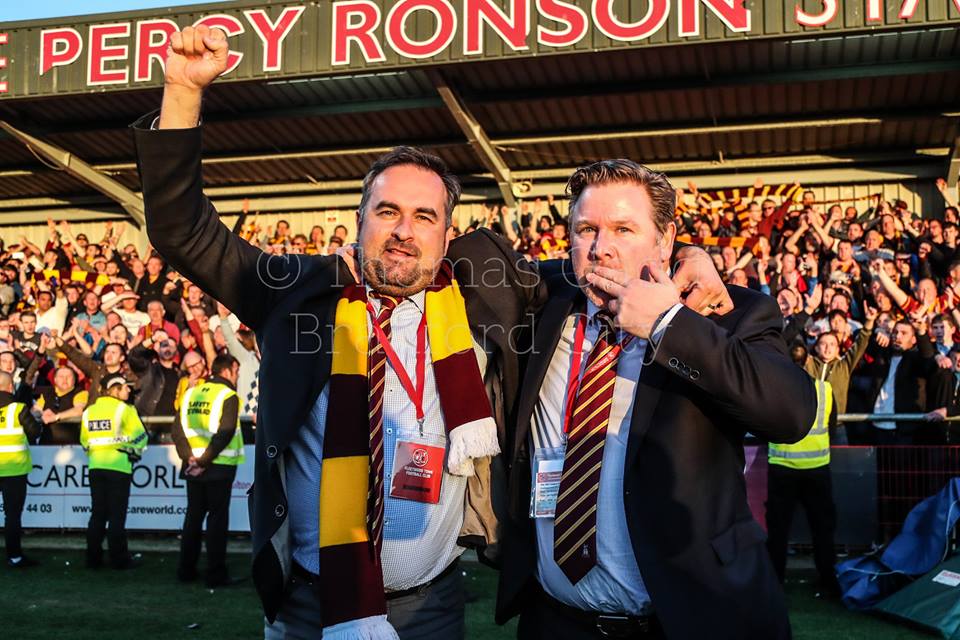
I was in the away end that night, and all I can remember about the game is Fleetwood launching a free kick into the box, and the City defenders running out together to leave a collection of dumbfounded Fleetwood players offside.
“Town’s Wembley dream ended with a whimper rather than a bang” declared the local(ish) Blackpool Gazette. “It was just two games too many,” rued Cod Army boss Uwe Rosler.
It was the opposite case at Middlesbrough in 1988. City boss Terry Dolan told me when I interviewed him 10 years ago, “In the first leg we played very well. Even with the second leg, we were 1-0 down after 90 minutes and then went to extra time. I think by then, the extra games we had played with a smallish squad, it did take its toll.”
In 1988, City lacked the endurance they had in 2017, and in the play-offs that’s sometimes the deciding factor.
Momentum

There are broadly three types of play-off team mindsets.
First, there are the clubs who just missed out on automatic promotion and have to pick themselves up as they go in the play-offs. They’re disappointed to be here and often can’t get going again.
City were this sort of team in 1988 and to a lesser extent in 2017 and 2023.
At the other end there’s the teams who just make the cut, often due to a late run of good form. They have the momentum, and they often use it to their advantage. Each of City’s play-off triumphs came from being this team. In both 1996 and 2013 City were muddling in mid-table in March, only to blitz their way into the play-offs at the end and then keeping it going.
The third type are those clubs in between. They’ve known for a while they weren’t automatic promotion material, but that they had a good shout of finishing in the play-offs. The run-in was about sealing the job and not messing it up, and then giving it their all in the play-offs.
City were that sort of team in 2016, and they’re that sort of team again this time. They very much rock up with good vibes and excitement – rather than nursing pain from missing out on something bigger.
The margins
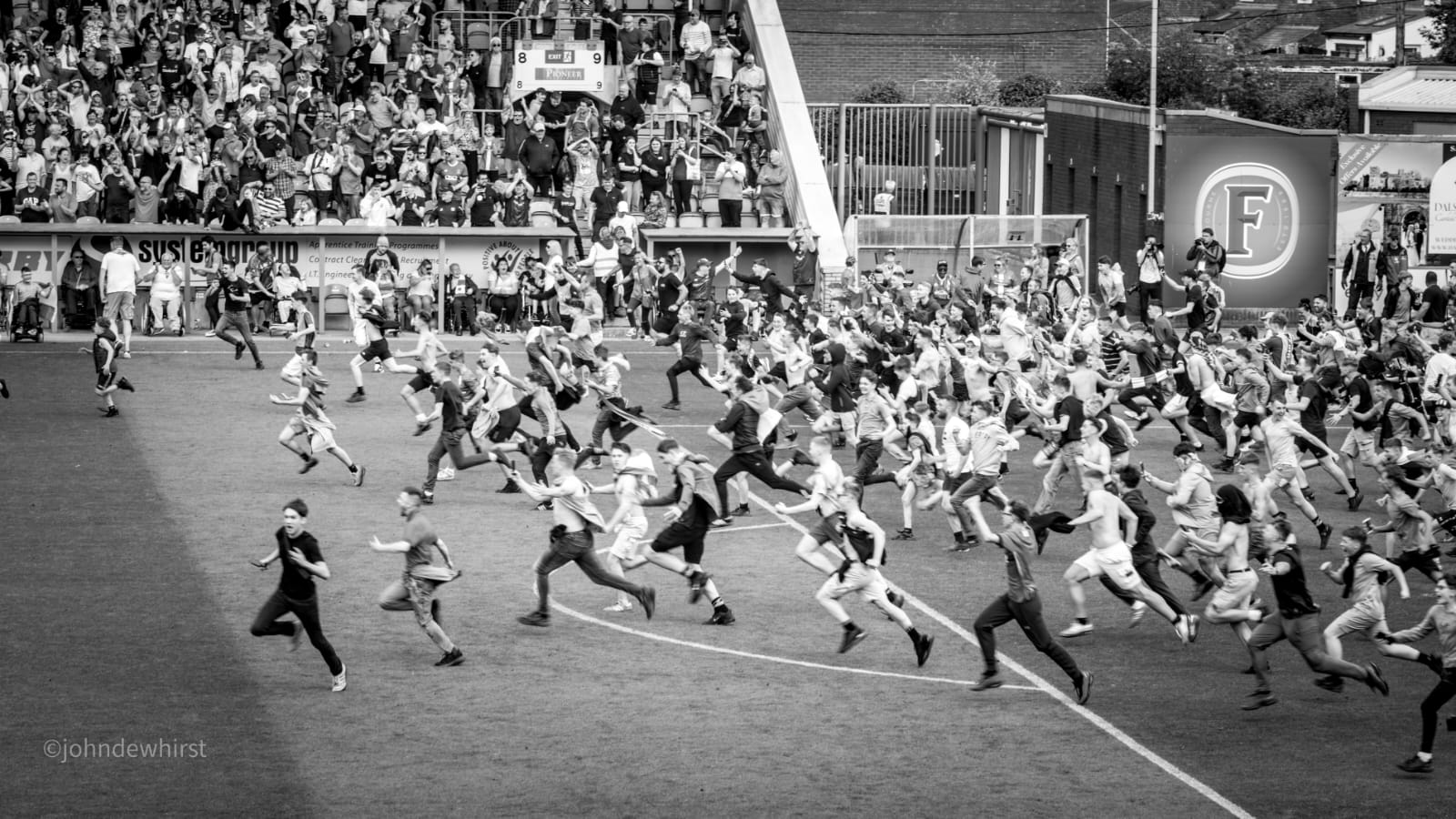
Morison was offside when he scored at Wembley in 2017. But Garry Thompson’s long-range strike that got City back into the tie against Burton, in 2013, may have hit Gary Jones on its way, who was standing in an offside position.
During Blackpool’s 3-0 second leg defeat to City in 1996, the home side hit the post twice. In the 2016 first leg semi-final loss to Millwall, Filipe Morais missed an absolute sitter as a 3-1 down City chased the game. A year later in the first leg with Fleetwood, Colin Doyle kicked the ball to future City player David Ball, who almost successfully chipped the City stopper to score. And when City got to Wembley that year, Billy Clarke ran through on goal early doors and should have found the back of the net.
What-ifs plague almost every City play-off game. And they linger in the mind of the losing team’s supporters, torturing them for months and even years.
Era-changing
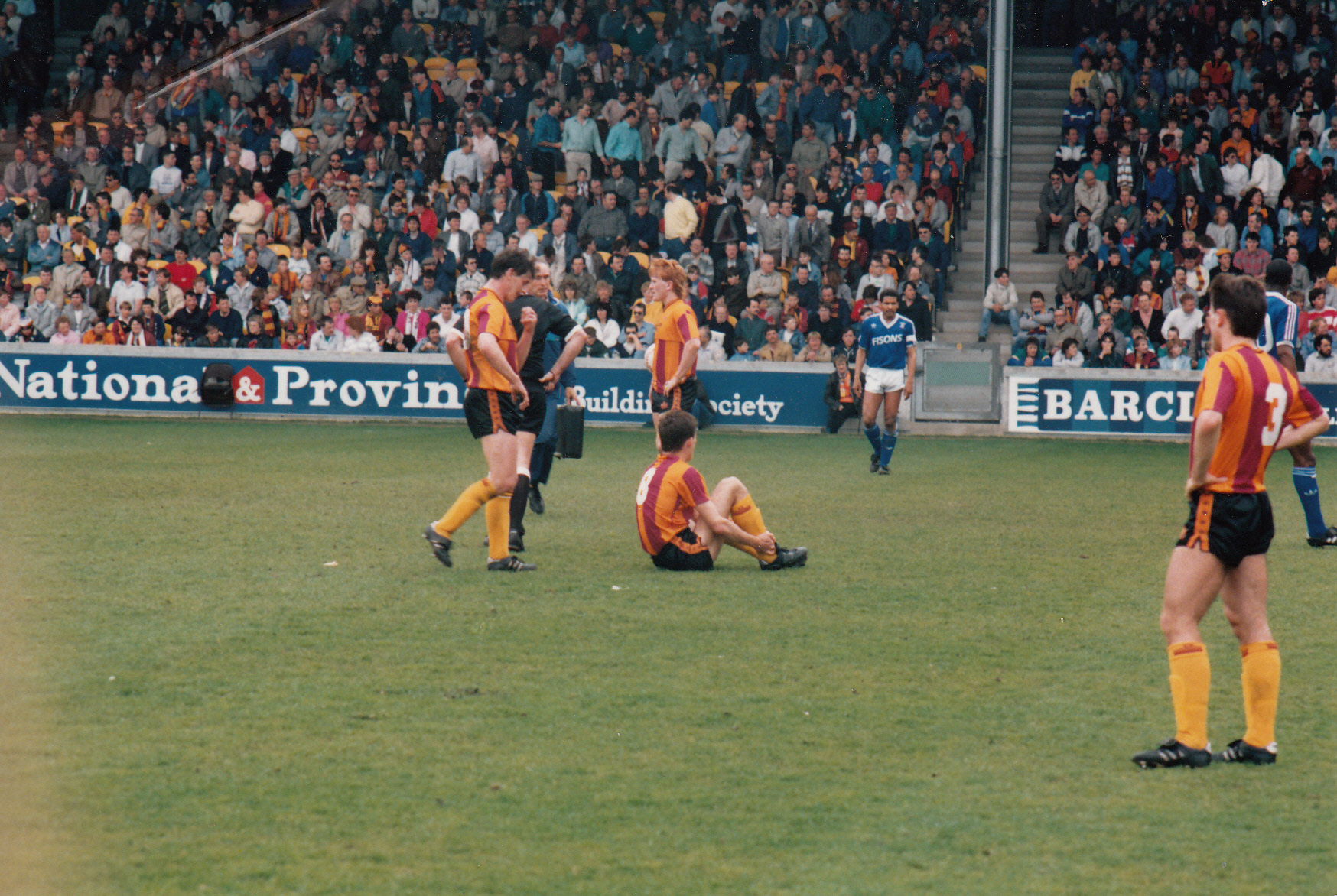
The high stakes situations the play-offs conjure up can sometimes have significant consequences – especially if City lose.
Take Middlesbrough 1988. City had the colossal talents of Stuart McCall and John Hendrie, who were routinely linked with top flight sides. The summer before, the pair had been persuaded to give it at least one more year at Valley Parade to see if City could deliver First Division football.
So when City lost at Ayresome Park, McCall and Hendrie’s time in BD8 was up. “I always said if Bradford City had won promotion, I’d have signed a ten-year deal,” Stuart told me when I interviewed him for a book 10 years ago. McCall and Hendrie left for Everton and Newcastle respectively. City banked some decent money but couldn’t spend it wisely. It would take them 11 years to get into such a position again.
In 2016, the semi-final loss to Millwall proved to be Phil Parkinson’s last match in charge. Before the second leg, Julian Rhodes and Mark Lawn had finalised a deal to sell the club to Edin Rahic and Stefan Rupp. Parkinson had one meeting with Rahic and quickly ruled his future lay elsewhere, moving to Bolton. But what if City had beaten Millwall and then triumphed at Wembley? Would Parkinson have stayed that summer to lead City in the Championship, Rahic or no Rahic?
We’ll never know.
Parkinson chose to leave, but there are cautionary tales from City play-off defeats of the past for Graham Alexander, if City fail this time. In the three other play-off campaigns where City didn’t succeed, they sacked the manager who got them there within 12 months. Terry Dolan paid the price in 1988. Stuart McCall in 2017.
As Hughes (and that bloody sub!) proved, play-off defeats can be the beginning of the end.
Legacy defining
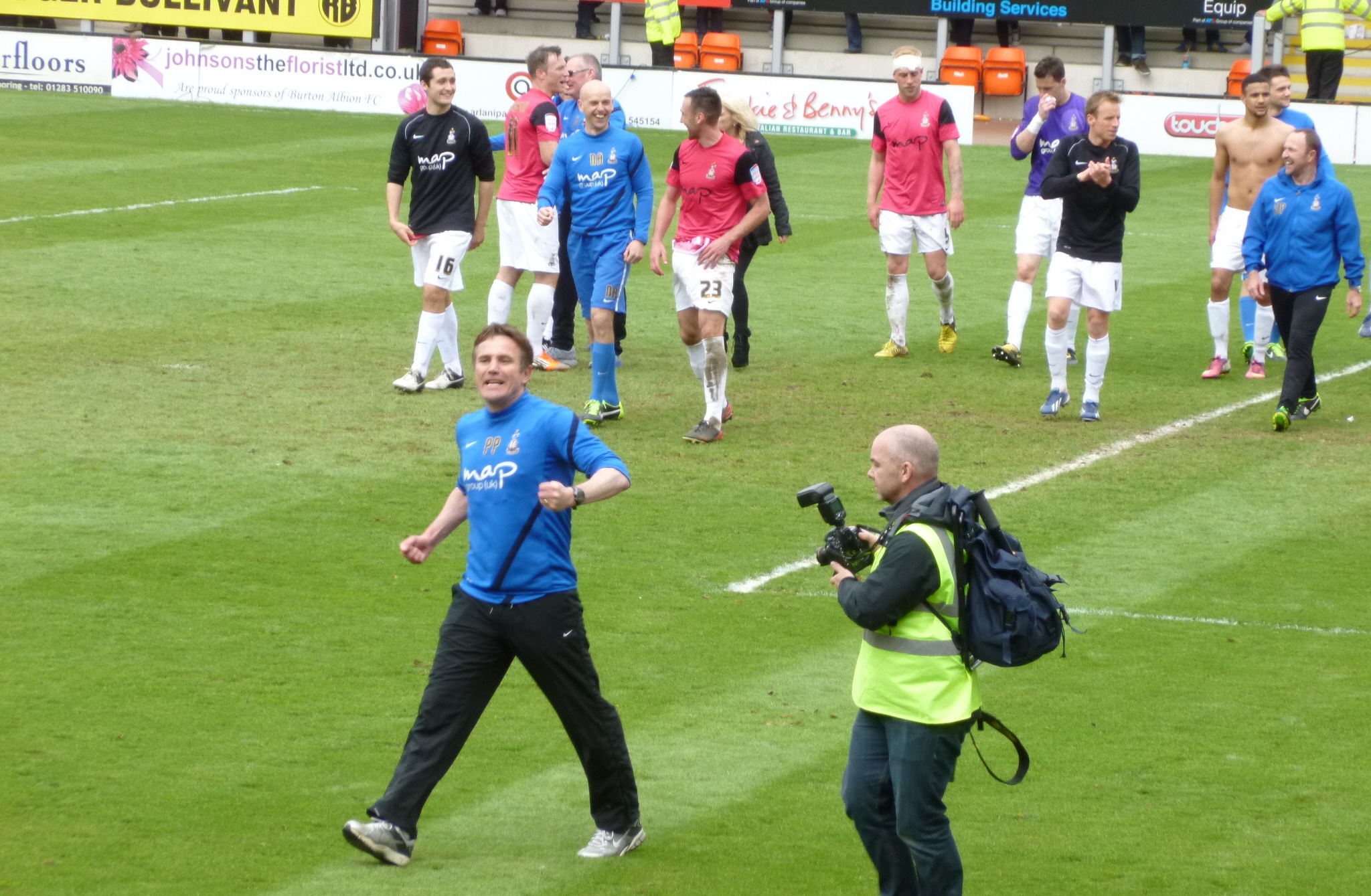
On the other hand, a play-off triumph can cement your legacy and ensure you go down in City history. That you’ll keep being invited back for celebratory dinners. That you’ll be forever a hero.
Chris Kamara achieved that status in 1996. Phil Parkinson got there in 2013. The players who they managed are similarly held in the highest of esteem. Wayne Jacobs, Lee Duxbury, Andy Kiwomya, Nicky Mohan, Jon McLaughlin, Andrew Davies, Stephen Darby and James Meredith.
Part of history

Whatever happens next will go down in Bradford City folklore.
Not just in terms of the implications of success or failure, but in going through a shared lived experience that none of us will forget.
Middlesbrough 88, Blackpool 96, Burton 13, Millwall 16 and 17, Carlisle 23 – these names and dates invoke a collection of personal memories that every City fan who was there for them will take to their graves.
Where were you on 15 May 1996? Did you camp out for Burton tickets in 2013? Were you one of the City fans who went all the way to Millwall in 2016 and – because of awful traffic – didn’t get home until 8am the next day? Were you at Fleetwood to see Edin and Stefan dancing on the pitch? Did you have to look twice at the electronic board at Brunton Park because of that sub? Have you proudly worn claret and amber down Wembley way? Have you cried inside Wembley?
Moments that will live forever.
Because that’s what the play-offs are: the absolute extremes of football emotion.
No middle ground. Just everything.
Enjoy what’s coming.
Categories: Opinion, The 2025/26 play offs
 From Premier League dreams to League Two despair to League One play-offs: the beautiful misery of Bradford City
  widthofapost.com
Great article Jason,
I have been lucky enough to attend all the games mentioned, and, as with all other City fans the memories are bittersweet, would I have missed any of them, not on your Nellie !
Really looking forward to the next 2(3) games and praying for more great memories.
Great article. Watched the 1988 second leg in the Middlesbrough press box after a journalist friend got me a ticket in there; did an interview with Chris Cooper of Radio L666ds on Wembley Way before the 1996 final, reporting on Bradford City London Supporters FC’s win in the final of the London Supporters Cup the day before; in 2013 was living and working in India but flew back for the final; was at home and away legs v Millwall in 2016, home leg v Fleetwood and final v Millwall in 2017, and home leg v Carlisle in 2023. Hoping to get tickets tomorrow for home leg v Bolton, and to see City promoted to the Championship at Wembley.
Great trip down memory lane Jason, and excellent prelude to our forthcoming games.
Regarding May15th 1996, my Wife’s best friend had arranged to get married on the same day as the final (I mean who gets married on a Sunday!). I was very reluctant to miss the game, to say I wasn’t happy is an understatement. However, having been told it would be rude to miss the brides special day, I agreed under much prostestation to go to the wedding, attached to the radio.
At the speeches, the Groom stood up and announced he had to have a stand-in best man as his original best-man was at Wembley ! I was livid.
I’m even irritated by it now writing this haha
Brings back many mixed memories! The attendance in 1996 was just under 40,000. I think you’ll find the vast majority were City fans outnumbering Notts County 3 to 1 so 30,000 City fans not the 40,000 in your article.
Yeah, was about 32/33k City and 8/9k County
So good, really shows that you need a good team to make the playoffs, quality players in all those clips.
I’m looking forward to seeing a clip of this play off in 20 years, seeing Sarcavic and thinking, now that was a player.
Des Hamilton scored one of the best ever Wembley goals, in my humble opinion. I can watch it 30yrs later, & it still blows me away 🙂
’96 was a great team spirit, just like now, everything crossed for another Wembley day in the sun.
Up the Bantams!
Des was also the first Bradford born player ever to score at Wembley !