

Written by Jason McKeown (images by John Dewhirst)
The margins are thin. Really thin.
Over the last 30 Bradford City League One games, the Bantams have only netted 32 goals, whilst conceding 33. It’s led to a 30-game points haul of 45, which if extrapolated over a full season, would result in City finishing on 69 points – and an eighth-placed position, based on last year’s League One.
Those numbers just about pass the eye test of what we’ve witnessed since the middle of September, where City brilliantly defeated Cardiff City 3-1 away to go top of the table in game nine of the league campaign. It was part of a blistering start that saw the Bantams average 1.89 goals for, 1.22 goals against and 2.22 points per game. Had City been able to maintain that early season pace, they’d have ended the campaign with 102 points – good enough for automatic promotion, based on last year’s League One.
It is, of course, unfair to split City’s league performance in two. Overall, they are fourth in League One, and the table does not lie. But there is a longer-term trend across these 30 games that suggests – like a glider coming into land – City are relying on early-season points in the bank to seal a top-six finish. It also highlights some key issues. Namely, the lack of goals.
Because defensively, City have actually improved since that amazing start, conceding 1.1 goals per game over the last 30 matches compared to 1.22 over the first nine. But the 1.89 goals per game scored early on has dropped to 1.06 since Cardiff.
In other words, City are slightly better defensively, but their goal output has declined.
And that becomes a problem in lots of ways. After Saturday’s defeat at Burton, doubts have been expressed about Sam Walker’s form. They are not unreasonable questions, but the fact is City missed good chances at 0-0 that should have put them in a commanding position. If Walker is not doing his job as well as we’d like, what do we say about those up front?
It’s all part of long-term trend: City have struggled to find a regular goalscorer. And it goes all the way back to Andy Cook’s ACL injury at Barrow 15 months ago, or perhaps more accurately his booking in the home game against Barrow a few weeks before that. That led to a change of system that has delivered spectacular results, lifting City from League Two mid-table to closing in on a League One play-off finish.
The 3-4-3 has been an unqualified success. But it has left one, recurring weakness – one that right now feels especially acute.
Does this system allow for a regular goalscoring central striker?

Why 3-4-3 works so well
One-and-a-half games into Graham Alexander’s reign as City boss, he abandoned a back four in favour of a back three. First, the Bantams became a 3-5-2 side, before moving to 3-4-3 in December 2024.
Three at the back has proven inspired, especially at home. The width of the Valley Parade pitch is famously narrower than most grounds, allowing three centre-halves to cover space effectively while others push forward.
That includes the wing-backs, where Alexander has typically fielded a more attack-minded wing-back on one side compared to the other flank. Last season it was Tyreik Wright/Lewis Richards/Tayo Adaramola on the left, with a more defensively solid Brad Halliday on the right. This year, the right-sided Josh Neufville has taken on the swashbuckling role, with Ibou Touray more conservative on the opposite side. More recently, however, Wright’s defensive improvement and growing confidence going forwards means City now favour two attack-minded wing-backs.
In midfield, Max Power is the glue holding it all together, taking over from Richie Smallwood in the summer. Jenson Metcalfe has won the race to become his regular partner, leading City to dispense with the more goal-oriented Alex Pattison and Tommy Leigh.
Where 3-4-3 has really worked is in the success of the wide forwards. Since the switch, Bobby Pointon has scored 13 goals in 49 (9) appearances, while Antoni Sarcevic has 17 in 45 (9) league outings. Alexander recently stressed that 3-4-3 is not rigid, and Pointon and Sarcevic embody that flexibility. When attacks build on one flank, the opposite wide forward moves centrally to support the striker. How often have we seen one of Pointon and Sarcevic arrive in the box to finish attacks from the other side?
The pair have become huge, huge players under Alexander.
The system allows City to transition quickly from defence to attack and press relentlessly in the final third. Defenders such as Aden Baldwin can play long, accurate passes. Midfielders like Power and Metcalfe channel attacks effectively. Wing-backs and wide forwards operate in synchronised partnerships. And defenders like Matt Pennington and Curtis Tilt press high and win the ball back.
When the 3-4-3 clicks, it is a sight to behold.
Where does the central striker come in?
Over the last 16 months, different central strikers have been tried in this system, all with similar responsibilities.
First and foremost, they must act as a target for quick transitions. Long balls are directed towards them, and they are expected to compete physically and disrupt defenders. Pace, athleticism, and movement are crucial – arguably the number one attributes.
Take Calum Kavanagh as an example. He became the prototype for the role last season after Cook’s injury. While not as dominant aerially, he offered greater speed and agility.
What Kavanagh did exceptionally well was his movement. He created space and made himself a target. Even when he didn’t win headers, he made life difficult for defenders, allowing City to win second balls and push up the pitch. Without necessarily touching the ball, he enabled the team to press.
It was highly effective. And whisper it quietly – possibly more successful than if Cook had remained fit.
It’s true it didn’t yield a Cook-level number of goals from the central striker. Kavanagh scored nine league goals in 25 appearances, while understudy Michael Mellon managed just two in 15.
But it didn’t matter. The team as a whole became more productive, moving away from reliance on Cook and towards a more evenly distributed goal return.
In 2024/25, up to and including the Barrow home draw (the last time City played 3-5-2 before the 3-4-3 switch), City had scored 22 goals in 17 games, with Cook bagging 10 of them (45% of goals for a City team averaging 1.29 goals per game). In the remaining 29 league matches of that season, playing 3-4-3, City scored 42 goals, averaging 1.44 per game.
The remarkable aspect of 2024/25 was this: despite losing one of the greatest goalscorers in the club’s history, the Bantams became more effective and more prolific.

How has this evolved?
For the 2025/26 assault on League One, City brought in Stephen Humphrys and Will Swan to compete for the central striker role. Kavanagh was desperately unlucky to pick up a serious injury in pre-season, which left him playing catch-up and ultimately led to his January exit. Cook edged closer to a return to fitness, but no one really knew if he would fully recover.
Humphrys and Swan were different to Kavanagh, but retained that key characteristic of being effective pressers and doing important work off the ball to get the team up the pitch. Much has been debated about Humphrys’ best position, but for a time it worked well having him centrally, with the freedom to drift wide when opportunities arose. He provided memorable contributions from wider areas too – setting up Pointon’s equaliser at home to AFC Wimbledon in August, and winning the decisive penalty at Plymouth in December. This greater movement offered another layer to City’s attack.
As with Kavanagh, plenty of high balls were sent towards Humphrys, and he struggled to win many. But, again like Kavanagh, he made life difficult for defenders and gave the team what it needed. Whether he was fully enjoying the role is debatable. His body language wasn’t always convincing, and – not unreasonably – he probably felt he had more to offer.
Swan took his place for a time and went on an outstanding early-season run of goals. In hindsight, though, it looks more like an anomaly than a sustainable trend. A run fuelled partly by opposition mistakes – notably from goalkeepers – which Swan capitalised on brilliantly, but which was never likely to continue at the same rate.
That’s not to diminish Swan’s contribution. You could immediately see how his pressing fit the profile City were recruiting for. And, just like Kavanagh and Humphrys, a large part of the role is about selflessness rather than being on the end of a steady supply of chances. Swan hasn’t maintained his early numbers, but he rarely lets the team down.
January swaps
Nevertheless, City’s drop-off in goals inevitably became a key focus heading into the January window. Cook was now fit again, but it quickly became clear he could not press or make the runs the system demands, and he was sidelined. Humphrys and Swan were contributing, but not producing significant goal returns.
In those first nine games, City scored three goals on three occasions and two goals on three occasions. But after Cardiff and up to January – a run of 13 games – they failed to score more than twice in any match, and only scored more than once on four occasions.
January presented an opportunity to address this. In came Kayden Jackson, Ethan Wheatley and Paul Mullin. But finding a striker to contribute more goals in the central role still eludes City.
Jackson has looked the most promising of the arrivals. He offers something slightly different, with the ability to run in behind as well as press defenders. His pace and movement are strong, and City have often looked better with him leading the line – but not necessarily more prolific.
Like Swan, Wheatley appears to tick many of Alexander’s boxes. He can press, make intelligent runs, and unsettle defenders. Like the others, he doesn’t win many aerial duels, but at his best he disrupts defences, helps the team move up the pitch, and works tirelessly.
Mullin, however, does not appear to fit the mould. He’s not the tallest, and his decision-making and timing – particularly compared to someone like Humphrys – can be lacking. He is combative, but gives away too many free-kicks, and overall doesn’t look like a natural fit for Alexander’s system.
None of these January striker signings have shifted the dial. But being fair, the club’s lofty position requires players of a certain calibre and cost that is probably beyond the Bantams. Maybe they could have pushed the boat out more for a Jake Beasley, but it’s a heck of a risk.
City played it relatively safe instead. And maybe that’s a mistake when judged through short-term lens, but maybe it puts them in a better position come the summer.
The crux of the issue
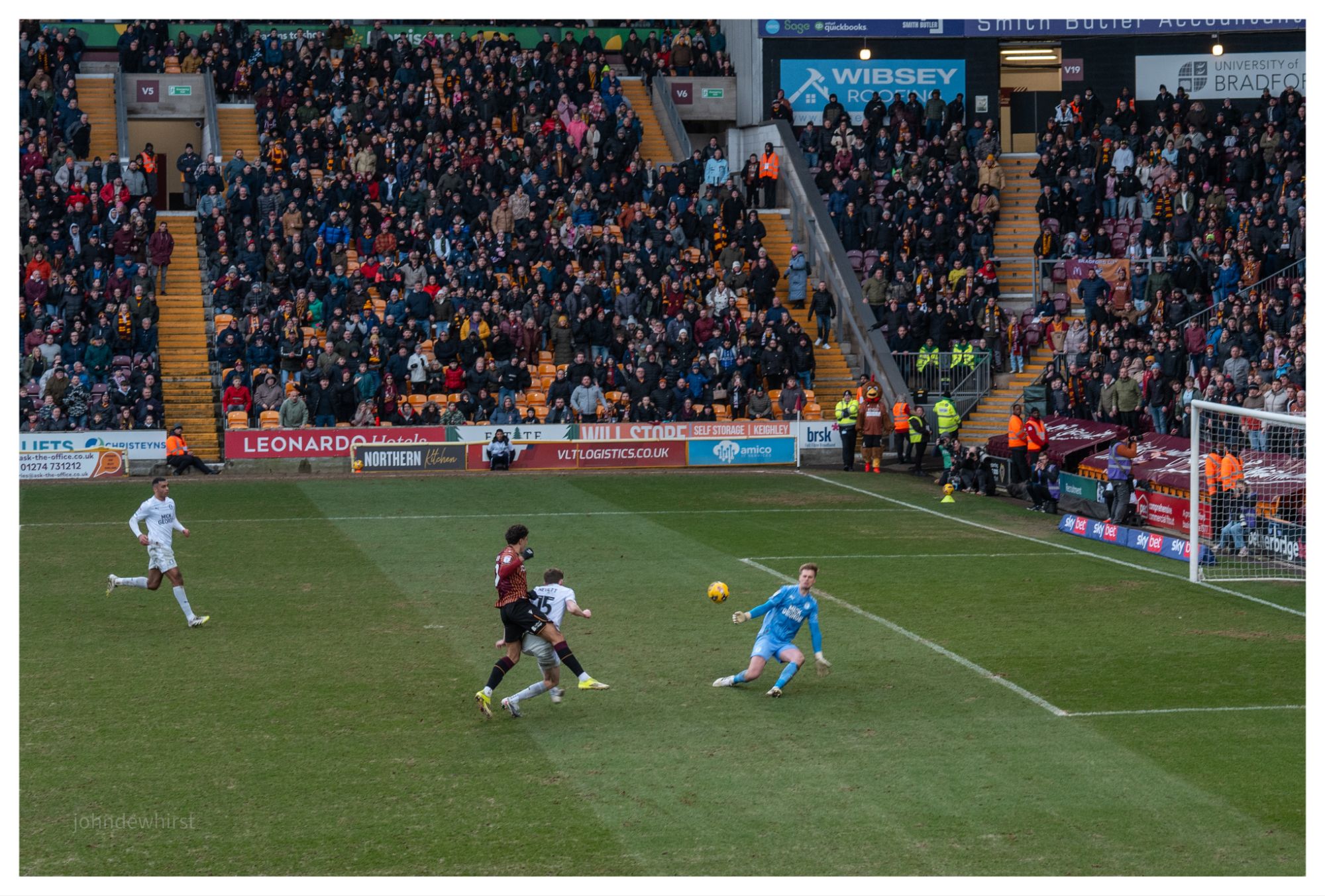
Since Boxing Day, just two Bradford City goals have come from a central striker in the 3-4-3 system – Swan’s late winner at Blackpool and Jackson’s header against Peterborough. Humphrys has scored a couple in that period, but those came either from a wide role or when City switched to two up front while chasing games.
In the standard 3-4-3? Two goals from central strikers in 18 games – or 1,620 minutes.
That is not a sustainable return for a team chasing promotion.
City have been unfortunate with Jackson’s injury, but no one has stepped up to provide goals from that central role while maintaining the selfless work the system requires. That, in turn, places added pressure on others.
And there has been a drop-off there too. Sarcevic remains City’s top scorer with 10, but has only netted three times since mid-December. Pointon, just behind on nine, has scored only twice in the same period.
As well as failing to find a central striker who can both facilitate and finish, City have not secured sufficient depth to ease the burden on Sarcevic and Pointon. Over the last fortnight, with five games in quick succession, both started every match, and Sarcevic limped off injured at Burton.
He should be fit for the run-in, but if either wide forward is sidelined, City could face serious problems.
The goals are still too infrequent
In keeping with the post-September trend, City have not scored more than twice in a game since the Cardiff victory. There have been dominant wins – such as against Peterborough and Port Vale – but without the scorelines their performances arguably deserved. Stevenage are the only promotion rival to score fewer than City’s 49 goals overall. In fact. the Bantams are just the 14th-highest scorers in the division, yet have League One’s fourth-best shots per game average.
All of which underlines a clear theme: despite creating chances at a top-four level, City’s lack of cutting edge in front of goal continues to mask the true quality of their attacking performances.
That puts pressure on the defence.
Over the last six games, City have limited opponents to just 13 shots on target. The issue? Eight of those have resulted in goals. That is not a strong reflection on Walker’s recent form, and there is perhaps an argument for considering a new goalkeeper next season.
But even so, Alexander would likely accept those underlying numbers. Conceding just 13 shots on target across six games highlights how defensively solid City have become. They are difficult to break down. Even if Walker’s shot-stopping does not improve, maintaining that defensive level should limit the damage.
The bigger concern is at the other end.
City remain in a strong position – six points clear in the play-off race with seven games remaining. But just three matches ago, that cushion was 10 points. And after a favourable Good Friday fixture against second-bottom Northampton, they’ll face five games in a row against sides currently pushing for the play-offs.
In short, it is not the easiest run-in.
That is why the “glider coming into land” analogy feels apt. City must avoid turbulence and navigate the final stretch carefully. Their blistering start provided a strong foundation, but over the past 30 games that advantage has been slowly eroded – by poor away form, by a competitive division, and by a lack of clinical finishing.
With clear skies and a steady wind, City should still land themselves a top-six finish. But it may be a much closer call than once seemed likely.
Unless, of course, a central striker can finally find their shooting boots.
| Timeline of Bradford City central striker output |
| August 2022 – December 2024 Cook scores 65 and assists 16 of City’s 196 goals – meaning he was involved in 41% of all Bantams goals during this period. |
| December 2024 – May 2025 Kavanagh scores nine goals in 25 appearances, supported by Mellon with two in 15. |
| August 2025 – September 2025 Swan scores six in eight league and cup games (but has only scored once since). |
| August 2025 – January 2026 Humphrys manages just four league goals in his first 23 appearances. He loses his place and has recently been used as a back-up wide forward. |
| September 2025 – November 2025 Cook scores twice on his return and nets a memorable goal at Newcastle, but does not start a league game and is soon left out of the squad. |
| January 2026 – February 2026 Jackson is deployed centrally and scores once in three starts before injury strikes. |
| January 2026 – March 2026 Mullin has started just two games, both ending in defeat. |
| January 2026 – March 2026 Wheatley misses big chances early on and is yet to score after six starts (plus five substitute appearances). |
Categories: Opinion
 Preston sack Heckingbottom: the phone call Bradford City don’t want right now
  Book review: The Bantams of Valley Parade
  The Burnley rivalry not every Bradford City fan shares
  widthofapost.com
A very good in-depth analysis Jason. A bit worrying that we’re not scoring many goals but a comforting thought that we’re not conceding. But 8 goals from 13 shots on target in six games is worrying? Think Walker needs to work on putting himself in good positions? As the legend Gordon Banks used to say “being in the right place at the right time made it easy”. He needs to read the game better. It’s going to be a bit of a rollercoaster ride now to the end of the season with a lot of twist and turns with all teams involved. It’s whoever has that winning mentality to succeed. As for the glider let’s hope it doesn’t go off course and crash, and that it lands safely at Wembley?! Then anything can happen with I’m sure the backing of a great support from the Valley! Up the Bantams….three points from the Northampton on Friday would put us nearer our goal!
A lot is made over form. I remember a drop in form from Sam Walker for a period last season where many were questioning his position.
He returned to form and at the beginning of this season was hugely important when we were scoring more goals but conceding more chances. Without him we would not have had the start to the season we have had and we would not be where we are now. If Walker is having a bit of a blip by his standards right now, then given his body of work we should have confidence he won’t be doing the same by the playoffs should we get there.
Over the course of a 46 game season Sam Walker will contribute positively, and as Jason rightly says we should have been comfortably in front before he had a save to make and nobody would be talking about him. While I’m not saying we can’t do better in the summer, I know we can do a lot worse.
Talking of forward play, wonder how Ibbotson is doing on loan. His five minute cameo at St Andrews was quite impressive.
I still think an ageing Cook with a now dodgy knee would have given us more than Wheatley and Mullin at this important stage of the season.
Think it’s safe to say – bar Jackson who’s now sadly injured – none of the January recruits have improved this team!
I could hardly believe how good we were at the start of the season. It was truly amazing. However opponents adapted to frustrate us and it doesn’t look like much thought was put into a plan B. Personally I think we shall still make the playoffs and our opponents won’t be time wasting etc, so anything could happen. Promotion or not, as long as it’s not a repeat of Carlisle I will be happy with what GA has done. A big rebuilding job if we do get promoted and if recent selection is anything to go by a big rebuilding job if we don’t. I did wonder if Wheatley is on a trial with a view to signing permanently.
The Wheatley signing was mooted for weeks in advance and I thought we must be signing a wonder kid. Sadly, he’s looked out of his depth. Rarely wins a duel, poor in the air and has no natural scoring ability. It’s a luxury to have someone in the team just because he can “run about a bit”.
The Mullin signing is a mystery. God knows what he’s costing us as a contribution towards his wages. Alexander never seemed to fancy him from day one and his sporadic displays reflect that view.
Swan is too lightweight and apart from his early purple patch, has looked ineffective when he’s been available since.
Jackson did look to have the necessary attributes and, hopefully, will be available before the season ends
When Sarcevic is unavailable I’m surprised Lapslie hasn’t deputised. I don’t recall him ever letting the side down, when called upon, and is always capable of scoring a goal.
I too wonder why he has not given Lapslie a run out. The guy must be straining at the leash. He’s a decent player and seems to have been under used- I’d rather give him a game than one of January signings.
Yes I agree. For a little fella he’s brilliant in the air.
Yes I agree. For a little fella he’s brilliant in the air.
Its a big ask to get a proven, prolific goalscorer in January, expect him to gel immediately with the rest of the team, the manager and the tactics and on top of thay expect him to be fully match fit from day one.
There’s a reason these players are available.
I think we have to be patient and trust GA and the rest of the team. If we make the playoffs then great – but if we don’t we shouldn’t disregard the progress we’ve made as a team and as a club.
Graham has shown consistently throughout his time at the club that he can solve problems, be it home form, Cook’s injury, formations etc. Lets see if he has the answers to the latest conundrums….
I feel like we’ve not looked as threatening going forward since we paired Metcalfe and Power in midfield. Neither seem willing to go attacking as we saw with Pattison and Leigh.
In addition we lack pace down both flanks and in the wing back positions.
My only hope is that learnings can be taken from this season regarding squad depth and quality
January’s influx of players have yeilded very little. Investment in players was low. I have watched Cooke at Grimsby and he has scored goals for them but otherthan that his involvement has been limmited. Often he has come off the bench. Rarely does he play a full game. It is clear we need a strong centre forward with goals and ability to lay goals on for others. We don’t have the funds to do that. The match on Saturday demonstrated how lacking we are in the striker department. Even after we scored, we looked impotent in front of goal. Investment is needed for next season. Otherwise, the problems we are experiencing now will continue.
I do wonder why we signed 3 really poor players in January, rather than one really good one
sibley mullin and white must be earning enough to pay for one decent player?
My two “elephants in the room” are:
Not one goal this season from our captain, who takes all dead balls.
The number of bookings we incur, match after match; five at Burton and I believe four against Mansfield.
Despite the click being set back to zero two matches earlier, these will mount up.
Despite the elephants, I’m looking forward to a fifth trip to Wembley and a third win !!
He takes many set pieces but he does not take direct free kicks.
Our best central midfielder of the last decade is comfortably Josh Cullen who scored 1 goal for us.
Thanks as always I respect other supporters views and opinions.
However Josh, at least, scored a goal and I don’t believe picked up two suspensions in one season for yellow cards.
Just checked and we have 101 yellow cards this season, highest in the league and when we get to the play offs could really hurt us.
Cullen also played a lot more games for the club. I just don’t think our captain’s lack of goals is a stick to beat him with.
Somebody has to stick up for Wheatley, he looks a tremendous prospect to me.
Alex Ferguson used to say he wasn’t worried if a striker is missing chances, it’s when the chances dry up he starts to worry.
Wheatley seems to have that magic knack of getting big chances for himself. Weirdly, you could say he’s a victim of his own success. He has looked a bit hesitant in front of goal, but no worse than that, he hasn’t missed any sitters I don’t think. The goals will come! As they say.
Let’s be honest, we’re pretty nailed on for the playoffs (touch wood!), and with no chance of the autos. If I were Alexander, I’d persevere with Wheatley, and get him ready for the showdown in May. If Jackson is fit by then, we’ll have two like-for-like centre forwards ready to go.
Wheatley is raw. In his brief spell with us he’s shown no sign of improvement. Three goals in forty senior appearances tells it’s own story for a so called striker.
I expected far more from someone of his background. He’s neither scored goals nor, as far as I can recollect, provided assists at City.
Even big money strikers at top clubs sometimes have shaky starts. Maybe you’re right and he just doesn’t cut it, but it’s too early to tell. He just needs one to go in off his shin or something and he’ll be reet. I would judge him once he’s settled in and scored a couple
Depends how you define “missed any sitters”. Does hitting the goalkeeper 3 times with one on ones count? There’s an old saying “I wouldn’t pay him in washers” that describes my feelings for the player given his performances whilst at City.
I sincerely hope I’m wrong and he will score the goals to propel City to Wembley and maybe beyond.
Stephen Humphrys doesn’t get any stick for missing one-on-ones… which is because he hasn’t had any… because he isn’t a proper striker. I’d play the player who’s getting the chances.
One-on-ones are hard! There’s a professional goalkeeper trying to stop you from scoring. Not sure why people think they’re easy, it must be about 50/50 with the keeper.
I’m very late to this article but wanted to write a comment, as I’ve been saying to friends and family, who are City fans, that in this current system we don’t rely on a traditional striker to score most of our goals; so this article really was a very well written and useful analysis of this. From Cook’s injury, it’s clear that Alexander has found more success, and a preference, for a mobile striker who can occupy defenders and make space for the wide forwards. Now, would we better off with a mobile and more clinical striker, yes of course. But, Alexander, in my opinion, has decided to prioritise a striker who’s mobile, can play across the front free and press. I will add to this, that our budgetary limitations have played a factor here. We clearly can’t afford a striker who is the full package (e.g. fast, good presser and clinical goal scorer). These types of players are at clubs in our league with much bigger budgets or in the championship OR were unknowns before the season began and will be snapped up by teams with bigger budgets in the summer. Given we are one of the best teams at pressing and interceptions in the league, you can see this is paying dividends.
The press starts from the striker and other forwards, so we need an athletic and mobile forward who can press relentlessly for 60-70 minutes before we swap them out for a fresh pair of legs. Just before Cook was injured our best goalscorers were shown to be Sarce, Pointon and Pattison. That’s continued to be the case this year with Sarce and Pointon. We are a team that’ll probably have 2 players on 10-13 goals and another 2 on 6-9 and then maybe 4-6 players on 1-5 goals.
We realistically won’t be able to afford a proven 20+ goal striker, who would fit in our current system, unless we sold Pointon, Neufville or Metcalfe for big money. We should be able to get a player who has potential to grow into one of these strikers, but, there no guarantees that they will burst onto the scene with us like Wells did and for every Wells there are probably 15-20+ who didn’t work out.
The fact we are 4th in chances made but only 14th in goals scored, demonstrates that we need more clinical players to tuck away these chances (E.g. Swan and Wheatley have missed several 1-vs-1s between them). If we’d been more clinical in games like Rotherham away or Burton away, before we fell behind, we’d probably have 3-5 more points from those 2 matches. As we’ve proven we are very good at holding onto leads but not good at rescuing points from losing positions.
I think ultimately, our January business demonstrates that we’ve had to get3 strikers who can offer different things (E.g. Wheatley = Pace, energy / Mullin = shithousery, nous, experience and finishing / Jackson = Aerial threat, pace). This is due to the fact we couldn’t afford to pay for 1 striker who is very good at all of those things.