
By Jason McKeown
There is a scene in the film adaptation of David Peace’s The Damned United where Brian Clough stands alongside Billy Bremner before the Charity Shield, convinced he has inherited Leeds United on his own terms. Then, as the national anthem ends, Bremner turns and salutes Don Revie in the stands. In that instant, Clough realises there are loyalties and connections that existed long before he arrived, and which he does not fully understand.
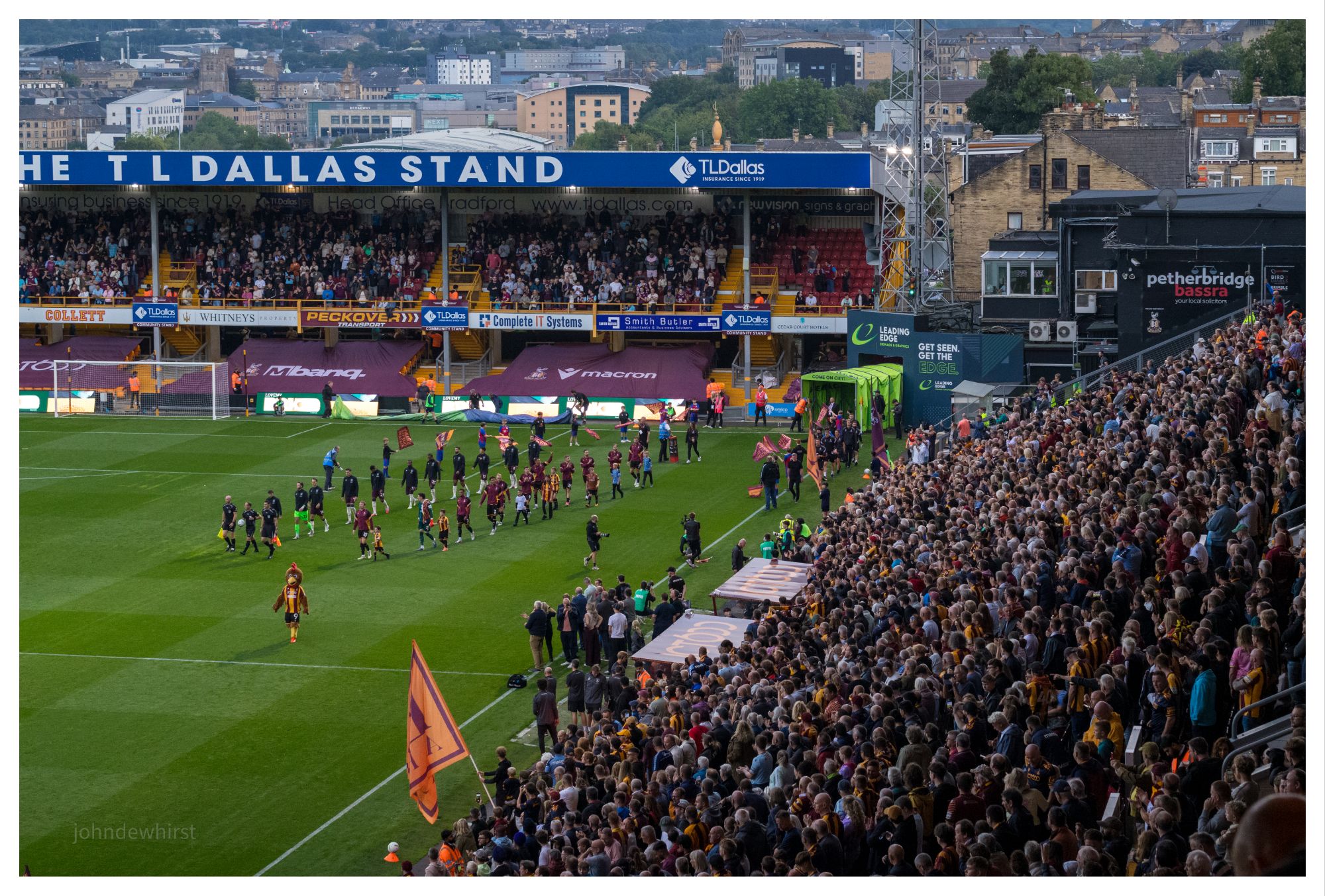
At the end of August, Bradford City welcomed Graham Alexander’s former club Burnley to Valley Parade. Asked beforehand about his time at Turf Moor, Alexander declined the invitation to reminisce. His focus, he insisted, was solely on Bradford City.
Yet, moments before kick-off, he made a point of walking over to the packed Burnley end and acknowledging the travelling supporters. It was a brief gesture, but a revealing one. For all the affection that had grown between Alexander and Bradford City, there were chapters of his story written elsewhere.
Less than a month later, that reality has hit home.
***
Preston’s imminent capture of Graham Alexander offered an uncomfortable reminder of where Bradford City still sit in English football’s food chain. Their rise from League Two to the upper reaches of League One has drawn admiration and envy, with their biggest asset lured away by a club offering the very destination the Bantams have spent the last 15 months plotting a route towards: the Championship.
The test now is whether City can respond like an ambitious club on the rise rather than one forced to start again. Has a lasting infrastructure been created to absorb this shock, or is too much of the club’s recent progress tied to the presence of one man?
We are about to find out.
The chair in Alexander’s office is not even cold and conversations about his successor have begun. Names are already being bandied about. Debates have started. At this crucial stage of the season, with everything on the pitch going so well, the need for a swift and decisive appointment is obvious. It would be all too easy for the noise to become a distraction and for City to lose the momentum they have built. These coming days may very well define the season.
The question is not just who Bradford City should appoint, but what type of manager they need right now. And the answer arguably lies in avoiding the trap clubs so often fall into when recruiting a successor: looking for something completely different.
Most managerial tenures end in failure, with a list of perceived shortcomings held up as reasons to change course. Was Stuart McCall too inexperienced, too emotional and too idealistic in 2010? Bring in the shrewd, pragmatic and measured Peter Taylor. Was Derek Adams’ football too functional and too difficult on the eye in 2022? Appoint the more expansive Mark Hughes.
Alexander’s departure is obviously very different. He does not leave behind a catalogue of failures that demand his work be torn up and started again. There is very little to criticise in the job he has done. This is not a rebuilding project and, given everything City have achieved under him, a continuity candidate seems the most sensible way to go.
It’s important to say of Alexander: other ways of delivering success are available. But the timing and circumstances make a dramatic change of direction exceptionally difficult without risking the stability City have worked so hard to create.
An enormous amount of planning has gone into building a squad tailored to Alexander’s demands. The intensity of pre-season in Austria, the emphasis on completing business early in the transfer window and the relentless focus on standards have all contributed to making City the well-drilled, single-minded outfit they have become.
Had Alexander left in the wake of the play-off defeat to Bolton in May, there would have been time to plot a different course. But 11 games into a season that has started so promisingly, a significant shift in direction could jeopardise everything that has been built. Given how hard City have worked to reach this position, that doesn’t feels like a dice worth rolling.
There are drawbacks to this way of thinking of course.
I’m a long-standing believer in long-term planning. Of appointing Bradford City managers with a greater vision than merely collecting the next available three-points. To replace Alexander with the nearest thing to Alexander possible, to keep this promotion push going, is short-termism that might have repercussions down the line. Even if it works, the ceiling of how far a like-for-like replacement for Alexander could take City might be lower than another available manager, who might need more time to get going but offer greater upwards trajectory.
Nevertheless, the opportunity immediately in front of City is too big not to attempt to grasp with both hands. Our modern history is a constant reminder that success is fleeting, and that finishing near the top of League One is an exception rather than our baseline norm. We could accept a backwards step or two in the near-term if it leads to greater long-term progress, but what if a backwards step leaves the club vacating a position they subsequently can’t get back to?
All of which makes it hard to argue for anything but a manager with the same characteristics, football philosophy and preferred style of football as Alexander. Sure, there’s room for tweaks and improvements. Only four League One teams have scored fewer goals so far this season. The central midfield solution is working so far, but doubts remain. Players like Stephen Humphrys might flourish with their copybooks wiped clean again. Tommy Leigh might be checking his Bristol Rovers loan contract to see if there’s a January break clause.
But the next Bradford City manager would do worse than let most things be.
Refine rather than reconstruct. Apply light touches rather than a sledgehammer. At least at first.
The other key quality City need in Alexander’s successor is organisational fit. It’s very clear that the Bantams’ resurgence is a team effort, with key figures working closely together and to a shared purpose. It’s why summer player recruitment drives have been so impressive. Alexander is clear in what he wants – Stephen Gent and David Sharpe go out and find it. Ryan Sparks has a reportedly strong relationship with Alexander, with Stefan Rupp overseeing from a distance.
The dynamic has worked wonderfully well, and any fragmentation from the joined-up vision could cause problems. When Mark Hughes left in October 2023, off-the-record stories of him not being on the same page as the recruitment team began to be drip-fed. History is always written by the winners and some of the accusations thrown towards Hughes may well be unfair, but whatever the finer details it seems people were on different pages in the tricky summer of 2023. The resultant squad build was disjointed and undermined promotion hopes.
City need a manager who will work closely and collaboratively with Sharpe, Gent, Sparks and others. The Brains Trust approach to strategy and decision-making has produced considerable reward. The next manager will have their own ideas for the type of player they want to sign and how to go about that, which is completely fine. But if it translates into disconnected approach, the club could easily undo its fine work.
So a lot to ponder, which makes the decision over the next Bradford City manager about a lot more than who has the best CV. The club has achieved considerable success operating in a very certain way. A manager that steers too far away from this could trigger a bumpy ride.
It is why there is so much on the line. For decades, Bradford City’s fortunes have risen and fallen on individual personalities. One manager arrives and everything changes. Another leaves and everything unravels. The hope among those running the club will be that they have finally built something more durable than that.
***
In The Damned United, Clough’s problem was that he underestimated the power of the structures and relationships he inherited. Leeds United’s problem was replacing Don Revie with a man determined to be Don Revie’s opposite.
Bradford City now face a similar crossroads. Alexander is gone. The challenge is not to tear up the blueprint he leaves behind, but to recognise its value.
The next appointment may tell us whether Bradford City have built something bigger than Graham Alexander, or whether too much of the structure rested on one man.
| GREXIT |
| Graham Alexander may be off, but something bigger remains |
| Pain |
| Preston sack Heckingbottom: the phone call Bradford City don’t want right now |
Categories: Opinion
 Graham Alexander may be off, but something bigger remains
  Pain
Pain  Book review: The Bantams of Valley Parade

No one is indispensable: the show goes on. We have been in this position so many times before and it’s part of the cyclical nature of football. The trick is to get the right replacement and we are now better placed for that than when we brought in Alexander precisely because we got his appointment right. He has left a solid foundation for the next guy to build on and maybe – just maybe – the new manager will bring new ideas and a slightly different approach that can get even more out of the squad. But, yes, here we go again. Alexander did a wonderful job and I hope he always gets a rousing cheer whenever he revisits Valley Parade.
It’s all set up for Clough jnr then!
Its often said that when a mansgerial.change takes place in football that the folloeing reaction is felt with the players.
A third look forward to it.
A third are ambilavalent to it.
A third dread it.
I imagine thats what is going through our players heads at the moment.
The King is dead, long live the King!