
By Alex Scott
After Saturday’s last-gasp equaliser from Doncaster’s Sean Grehan, Michael Duff’s start at Bradford City looks on the surface like a sharp detour from where the club was heading under his predecessor. One win from his first six league games stands in stark contrast to the five from seven that opened the season.
Yet look a little closer and Duff and the hierarchy that appointed him are increasingly taking heat for achieving almost the exact continuity they set out to deliver.
When David Sharpe and Ryan Sparks laid out the rationale for hiring Duff, the plan was straightforward. Sparks noted they wanted someone to “continue in the direction we are heading,” while Sharpe emphasised “we need tweaks, to a degree” adding that a key reason Duff got the job was that “the metrics were very similar to what we [were] under Graham”.
Navigating the rare spot of hiring a new manager while top of the table, most supporters were broadly on board. Once bigger names like Paul Heckingbottom and Dave Challinor stepped aside, appointing the former Huddersfield boss didn’t prompt an immediate outpouring of love from the fans, but the club explained the thinking clearly, and generally speaking, people were onside.
Duff reinforced his brief in his opening press conference, stating he wouldn’t “try and copy [Alexander], but [wouldn’t] go too far from where things are at the minute. It’s a balance.”
Given where City stood in the league, that plan made sense. Even so, a run of one league win in six, four draws, and a heavy home defeat to Huddersfield, has pulled City down to the edge of the play off spots. By results alone, the ‘continuity’ plan looks like it has stalled.
Except when you look at the underlying numbers, ‘continuity’ is exactly what they’ve got.
Across League One this season, City’s seven games under Graham Alexander and the six under Michael Duff occupy similar territory in terms of Expected Goals. One of the best defences in the division, and a below average-to-worse attack.
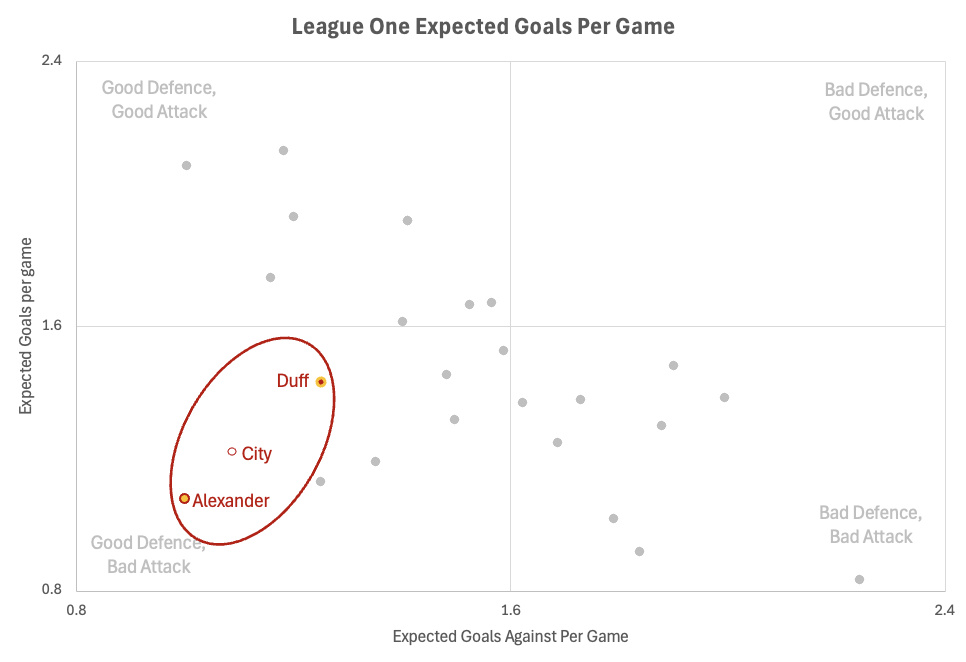
There have been tweaks, to a degree. Under Duff, in the league, attacking performance has nudged higher while defensive performance has consequently dipped slightly, leaving the overall expected goal difference in around the same place. If anything, on the underlying numbers, overall, they are in slightly better shape now than they were.
Of course, there’s a difference between Expected goals and Actual goals. Under Alexander, City matched their attacking xG and outperformed their defensive xG. Under Duff, they have underperformed their attacking xG significantly, by more than 50%, while their defensive overperformance has fallen slightly.
But overall, they have continued in the direction they were heading. Looking at their underlying performance across the season, City have been a top ten side, a tier below the promotion contenders, under both managers and cumulatively.
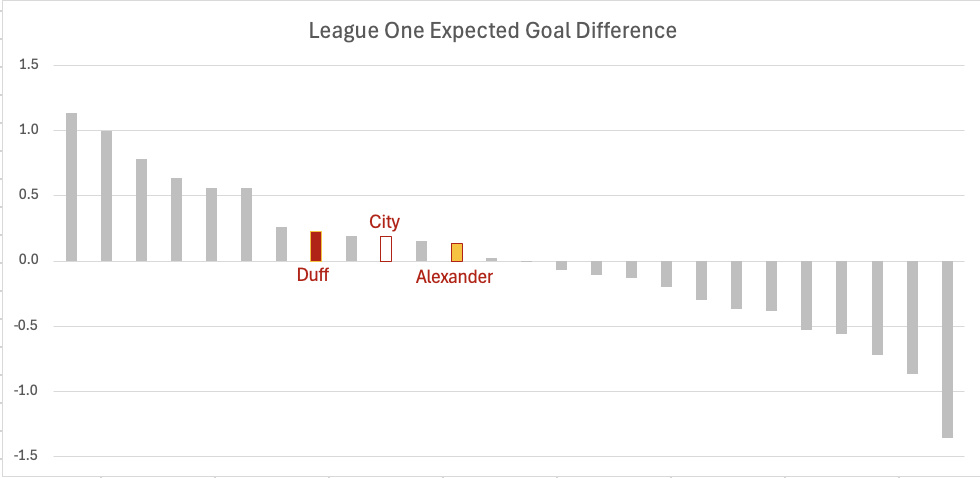
Noting that slight tweak in the balance to be more attack-focused, overall this underlying data paints a picture of a team whose league results, rather than showing a drop from the division’s best side to a mid-table one, have simply regressed closer to the team they have been all season.
Maybe Alexander’s side had built a habit of systematically outperforming expectations, or perhaps a succession of narrow 1-0 wins in otherwise even games flattered them. Maybe it’s a bit of both. Either way, City’s opening run was likely to be unsustainable regardless of who held the reins.
Criticising Duff and the hierarchy for appointing him because of a drop-off in performance misses the point that the underlying performance hasn’t fallen away at all. And the failings they are being criticised for now like the boring stretches of play, slight weaknesses defending set pieces and not being able to take enough chances and score enough goals have been issues for a long time.
As Jason noted over the weekend, despite the tweaks in balance under Duff, City now share the longest drought in the Football League since last scoring three goals in a game. When any team operates on such thin margins, they will also be vulnerable to small swings going the wrong way. A penalty being turned down despite your midfielder being punched in the head, a glaring miss by your striker from one yard out, or your defence inexplicably leaving someone completely unmarked in the six yard box from a corner in injury time, for instance…
A potentially more interesting critique may be that perhaps Sharpe and Sparks’s continuity plan was over-influenced by a short, strong run at the start of the season that defied the underlying performances. Perhaps they needed to think more about revolution than evolution?
Or maybe, City are still in sixth, have lost once in all competitions since the 1st of September, are still in all the cup competitions, and whilst they’ve been a bit unlucky in the league recently, everything is basically fine, will probably even out, and no one needs to be criticised at all?
For all the frustration around Saturday’s late equaliser, City are still in decent shape. They are still in the play offs with games in hand, their defensive foundation remains strong, and there are signs the attack is picking up. They’ve still only conceded ten goals in fourteen league games and as friend of the site Nathan pointed out on Twitter yesterday, four of these ten are from defending long throws, and most of the others can be put down to isolated individual errors and deflections rather than anything in open play. They are still an elite defensive team who don’t really give away chances outside of set pieces.
The bigger risk for Duff is that with a growing injury list, with three of their most important attacking players from the beginning of the season (and three of our top four picks in the now-cursed Podcast Player of the Year Draft) missing in Bobby Pointon, Jake Beesley, and crucially Tyreik Wright, they are going to have to start rolling the dice more to capitalise on their steady underlying numbers which might skew the overall balance even more. They could do with some Unexpected Goals from somewhere soon.
On reflection, keeping Stephen Humphrys past deadline day looks increasingly valuable and he seems all but certain to start up front on Tuesday night against his former club, Barnsley. Along with former teammate at Oakwell, Adam Phillips, whose own performances have been ticking (slowly) upwards too, Humphrys will likely be central to Michael Duff’s efforts to turn his attacking expectations into reality over the busy weeks to come.
Categories: Opinion
 Geoffrey Richmond: The man who changed how Bradford City saw itself
 Metrics
 Dream tie vs big opportunity?
 Why Bradford City look set to stick with the same tyres


Share your view